Sole Proprietorship in Singapore: Rules, Costs and Risks
Learn how a sole proprietorship in Singapore works, including registration fees, unlimited liability, tax, renewal duties and when to incorporate.
You're invoicing under your own name, working from a spare room, and wondering whether a company is worth the extra paperwork. The government fee for a sole proprietorship in Singapore looks small, which is why so many freelancers stop at the registration form. That low setup cost can hide a recurring personal compliance burden: renewals, income tax, MediSave and, if turnover grows, GST. The sharper question is not how to file the form. It is whether hiring, larger contracts or higher turnover still fit an owner who remains personally on the hook.
What a Sole Proprietorship Is in Singapore
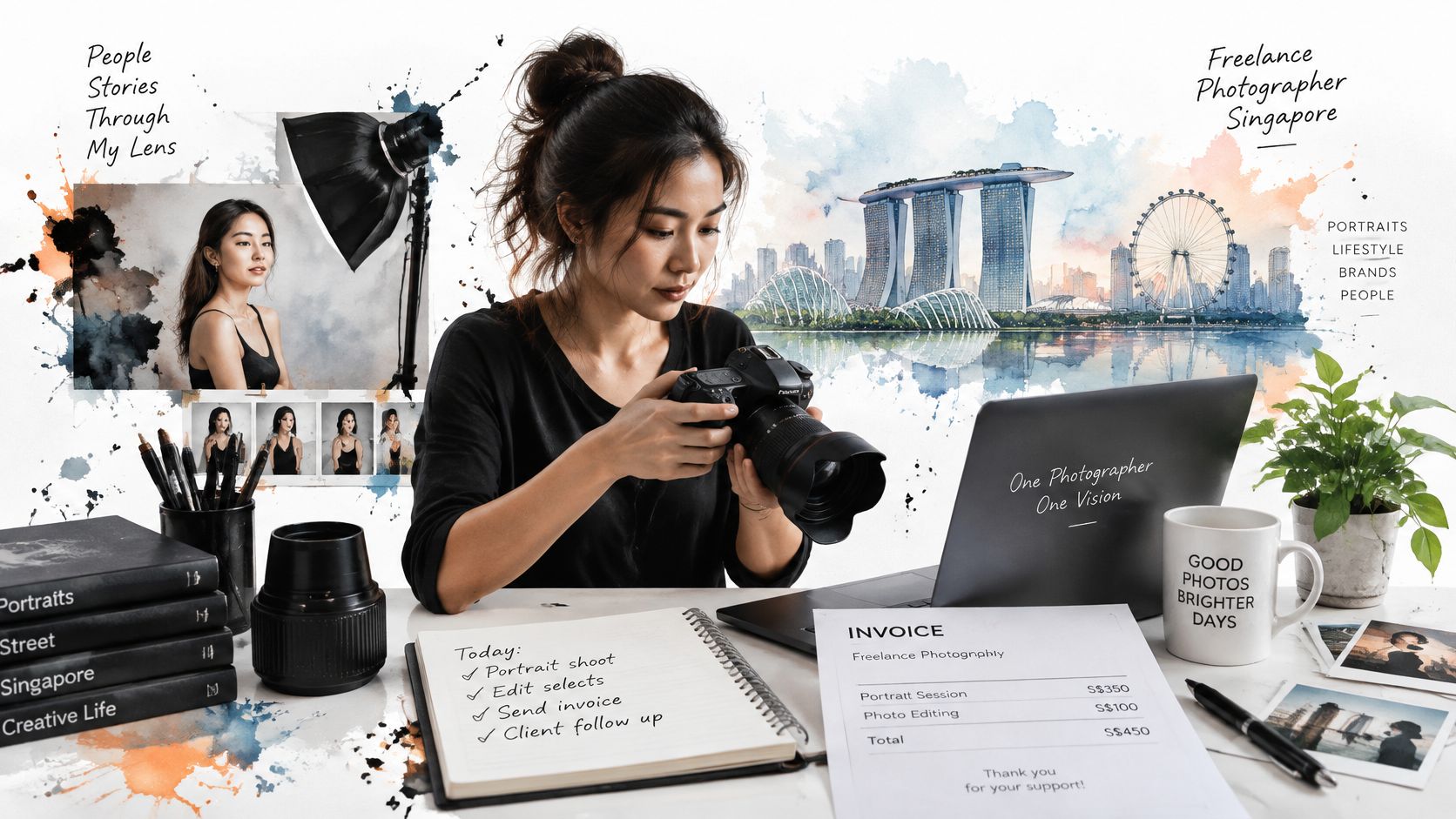
Say a freelance photographer takes paid shoots under her own name, with no company set up. She sends invoices, buys lenses and reports the profit herself. That is a sole proprietorship: a business owned and run by one individual, with no legal separation between the person and the business.
It is the simplest structure to start. A company is a separate legal person. A partnership joins two or more owners who share the business. A limited liability partnership sits between those ideas, with its own registration rules. A sole proprietorship does not create a new legal person at all. The photographer and the business are the same person in law.
Singapore's official business registry is maintained by the Accounting and Corporate Regulatory Authority (ACRA). ACRA records sole proprietorships together with partnerships as one combined category. In the data.gov.sg registry dataset summary, sole proprietorships and partnerships represented 49.2% of registered entities, compared with 48.3% for local companies. That published figure does not isolate sole proprietorships from partnerships. Even so, it shows how large the non-corporate share of the register still is.
Eligibility, government fees, personal liability, tax thresholds and the duties that continue after approval all sit on that same owner. This article is informative only and does not represent legal advice.
Registration Requirements and Fees at a Glance
Who can register
The owner must be at least 18 years old and, for local applicants, generally a Singapore citizen, permanent resident or eligible FIN holder, according to ACRA's guidance on choosing a business structure. An undischarged bankrupt ordinarily needs approval from the High Court or the Official Assignee to register.
Self-employed persons must also have their MediSave contributions up to date. This means paying any arrears or maintaining an active GIRO arrangement with the CPF Board.
Prepare a business name before applying through ACRA's Bizfile portal. The name application is mandatory, and its fee applies whether you choose a one-year or three-year registration term.
What you pay
The ACRA fee schedule sets out the government charges for name applications, registrations and renewals:
| Item | Fee components | Total payable |
|---|---|---|
| Initial one-year registration | S$15 name application + S$100 registration | S$115 |
| Initial three-year registration | S$15 name application + S$160 registration | S$175 |
| Renewal for one year | S$30 | S$30 |
| Renewal for three years | S$90 | S$90 |
The initial government fee is S$115 for one year or S$175 for three years, according to the ACRA fee schedule. Renewal costs S$30 for one year or S$90 for three years. ACRA's guidance on key requirements allows renewal up to 60 days before expiry. MediSave arrangements must be in place, with contributions paid in full or by monthly instalments.
Why the three-year maths matches
A one-year registration followed by two one-year renewals costs S$115 + S$30 + S$30, or S$175. Paying for three years at the outset also costs S$175. Both terms cost the same over three years. The choice is about timing and admin: a one-year term may suit someone testing whether the work will continue, while a three-year term means fewer Bizfile visits for someone planning to keep trading.
Practical rule: Compare the government fee with any professional help you may pay for name checks or filings, then choose the registration term that suits your plans.
To understand the fee structure alongside other Singapore setup costs, separate ACRA's charges from any professional fees. The ACRA amount covers the government registration step.
Why Business Debts Become Personal Debts
Think of a sole proprietorship as a household kitchen. The business and the owner share one pantry and one purse. A company is closer to a separate vending machine with its own coin box. Creditors of the company are usually paid from that box. Creditors of a sole proprietorship are paid by the person.
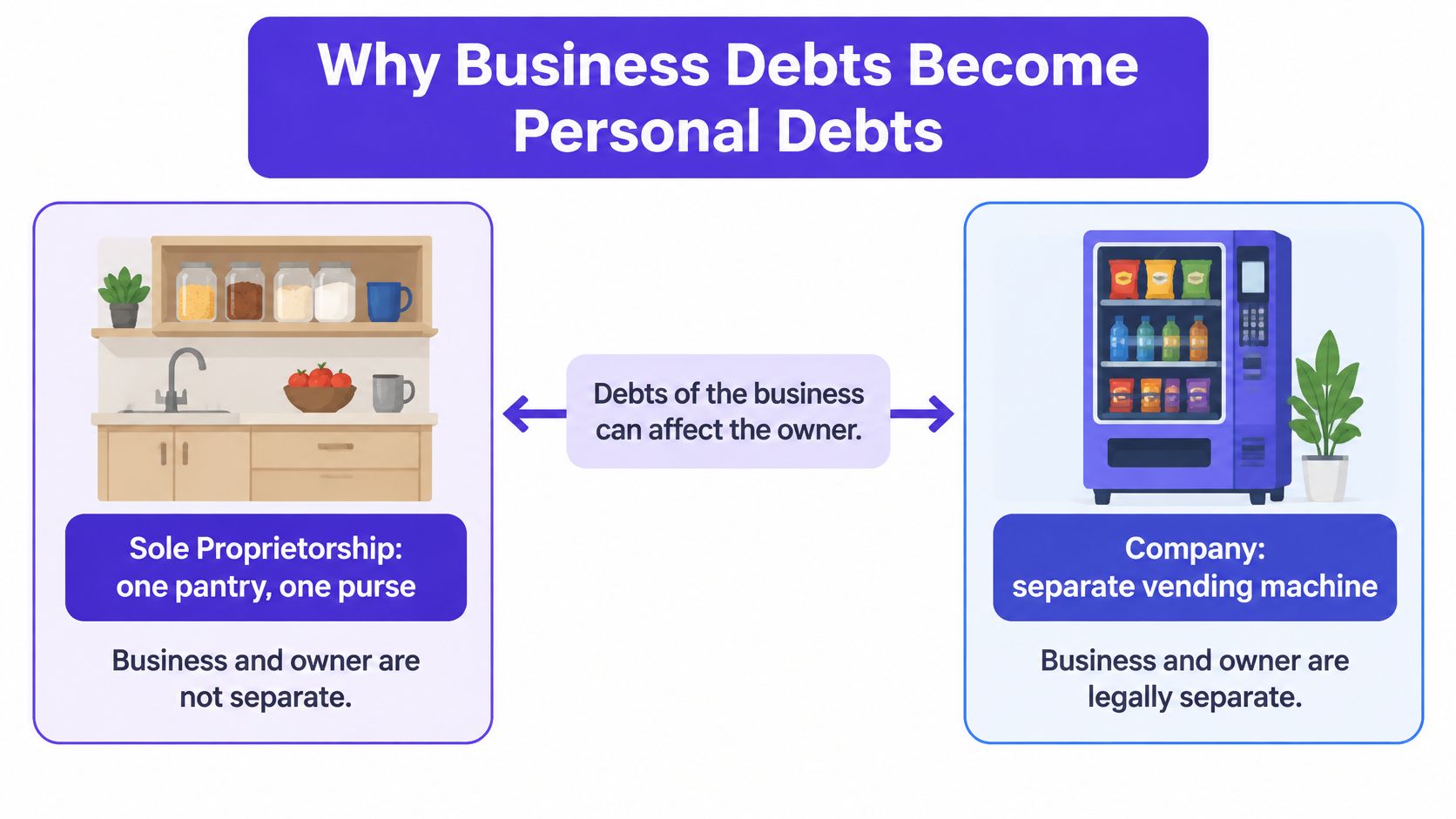
Because there is no legal split, the owner is fully liable for business debts and losses. Personal savings are not fenced off from a trading loss.
Say Ravi runs a part-time renovation business under his own name. A client wins S$60,000 in a claim over a defective job. The judgment can be enforced against Ravi personally. That means his personal bank savings and other personal assets, not only the cash sitting in a business account. The claim does not stop at the tools in his van.
Where exposure usually appears
- Mixed bank accounts: Card payments and supplier transfers leave a personal account, so a business shortfall is already sitting in the household balance.
- Lease wording: A shop or office lease often asks the individual to sign, so rent arrears follow the person if the work stops.
- Cards and loans: A credit card or loan taken for materials is still the cardholder's debt if clients pay late.
- Uninsured mistakes: A defective job, a late delivery or a data error can become a personal claim when there is no cover.
A company usually keeps business debts inside the company, unless the owner has signed a personal guarantee. Many small contracts still ask for that guarantee. Limited liability on paper does not help if you have promised to pay personally.
Three habits reduce the day-to-day exposure. Keep a bank account used only for the business, so you can see what the work owes. Read every contract for a personal guarantee clause before you sign. Where the work carries claim risk, look at insurance such as professional indemnity cover, and match the limit to the size of a typical job.
A separate account does not create a separate legal person. It does make the personal purse easier to protect and easier to explain.
How Profits Are Taxed and Which Thresholds Matter
A freelancer who bills S$90,000 and has S$30,000 of allowable expenses has S$60,000 in net trade income. A sole proprietor reports business income in an individual income-tax return, as IRAS explains. Allowable business expenses, capital allowances and trade losses affect the amount reported. Correctly classifying a lens, software subscription or work-related fare can change the tax calculation; a personal holiday is not a business expense.
Three amounts to watch
| Threshold | Amount and IRAS guidance | What it triggers |
|---|---|---|
| Net trade income | More than S$6,000 a year, according to IRAS guidance for self-employed persons | Compulsory CPF MediSave contributions for Singapore Citizens and Permanent Residents |
| Annual business revenue | More than S$200,000, under IRAS guidance on calculating business income | A four-line income statement instead of the simpler two-line format |
| Taxable turnover | More than S$1 million at the end of a calendar year, or expected to exceed that amount in the next 12 months, under IRAS's GST registration guidance/registering-for-gst) | GST registration |
For Singapore Citizens and Permanent Residents, compulsory MediSave contributions apply when annual net trade income exceeds S$6,000. Net trade income is the business profit figure after allowable expenses and adjustments, rather than the total amount billed. Because sole proprietors are taxed as individuals, their business income is reported at personal income-tax rates. The business does not make employer CPF contributions for its owner, so tax and MediSave obligations need to be considered separately.
The S$200,000 revenue threshold changes the reporting detail, not the tax regime: IRAS requires a four-line statement rather than the simpler two-line format. Revenue and profit serve different purposes here. Revenue is the business's income before expenses; net trade income reflects allowable deductions and adjustments.
GST has its own test. Registration is required if taxable turnover exceeds S$1 million at the end of a calendar year, or if it is expected to exceed that amount over the next 12 months. The test looks both backward and forward, so tracking monthly revenue can help identify when the threshold may be approaching. Before treating GST on a supplier invoice as a business cost, verify supplier GST status with Sambapay.
Keep supporting documents for income and expenses for at least five years. A clear record of revenue, expenses and turnover makes it easier to apply the relevant thresholds and report the right figures.
Ongoing Duties Most Owners Overlook
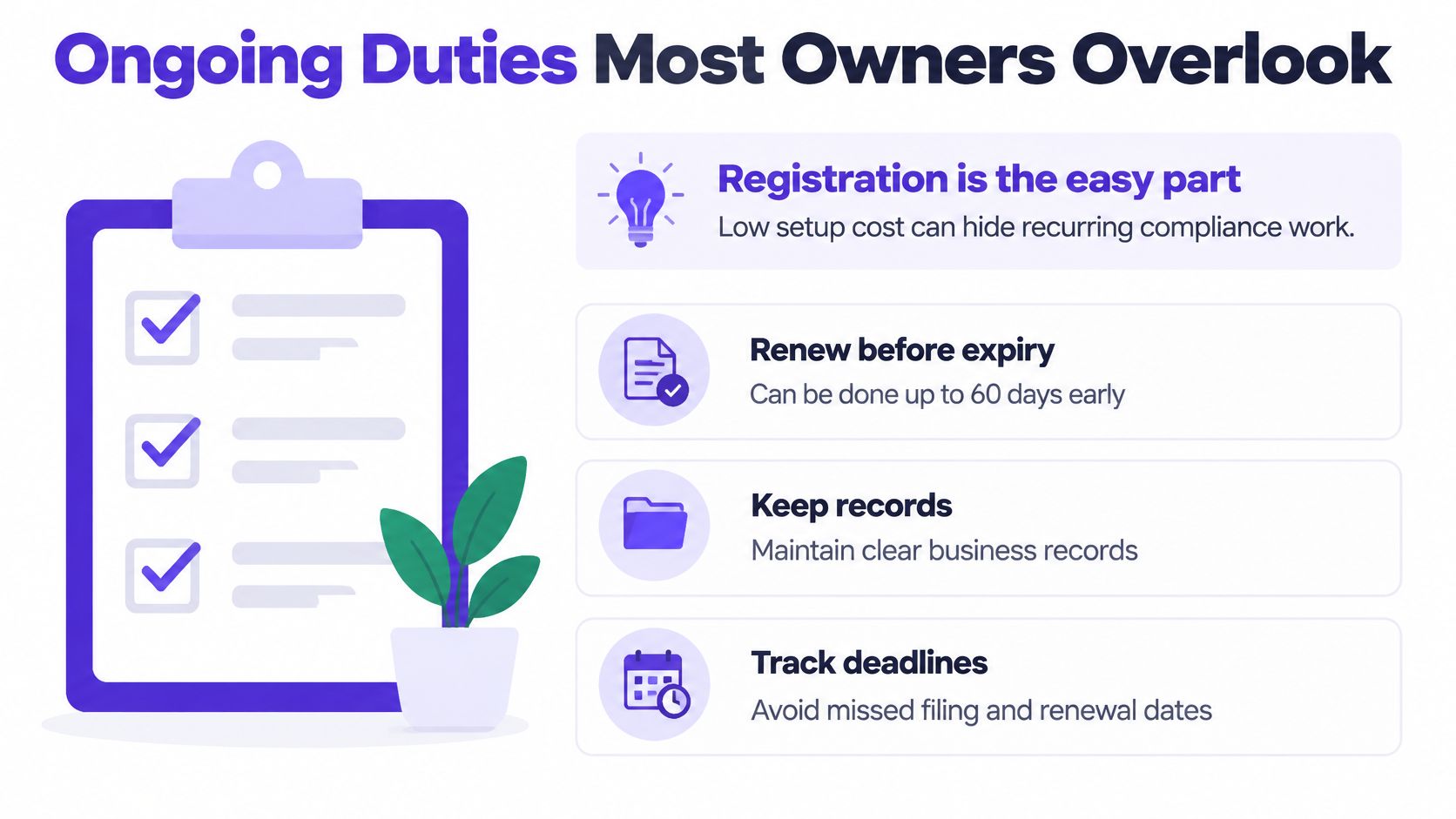
A change of business address can be easy to postpone when no payroll team sends reminders. Yet ACRA requires a sole proprietor to report changes to business or position-holder details within 14 days. It also requires registration renewal before expiry. Set reminders for both; personal responsibility for these tasks continues after registration. ACRA's guidance for sole proprietors and partnerships explains the requirements.
The duty list
| Duty | Timing | What to do |
|---|---|---|
| Registration renewal | Before expiry, up to 60 days early | Renew for one or three years with MediSave arrangements in place |
| Change of business or owner details | Within 14 days of the change | Report the change to ACRA |
| Annual income tax | Each filing year | Report business income in the personal return |
| MediSave contributions | Yearly, once net trade income exceeds S$6,000 | Pay in full or keep an active GIRO arrangement. IRAS explains the rules for self-employed persons. |
| Records retention | Ongoing, at least five years | Keep invoices, receipts and bank statements |
Use a calendar to assign each task a date and a reminder. For example, record an address change as soon as it happens, then set a deadline for the ACRA update rather than waiting for a notice. If a renewal is left until after expiry, or a change is reported late, the owner may face compliance consequences.
A monthly routine
- Reconcile the business bank account against invoices issued and bills paid that month.
- File every invoice and receipt, separating business and personal spending at transaction level.
- Compare year-to-date revenue with the tax and GST thresholds you are monitoring, including a forward look at the next 12 months.
- Check that the MediSave arrangement remains active, rather than relying only on last year's payment.
- Set a reminder 60 days before registration expiry, so renewal is not left to the final week.
If you run more than one activity or earn income from other work, check with IRAS and ACRA how turnover is aggregated before deciding whether a threshold has been reached. Hiring staff also brings employer obligations. Check the current requirements before the first hire.
Seek advice when turnover approaches a threshold, a contract asks for a personal guarantee, or an IRAS or ACRA query arrives.
Separate business and personal spending, and keep the invoices that support each deduction. If the monthly routine is slipping, bookkeeping and accounting roles with Cloudvara can help clarify which tasks a bookkeeper can handle and which remain your responsibility.
Scenarios and Growth Triggers
Registration of a sole proprietorship is usually quick, though ACRA notes that complex or referred applications can take 14 to 60 days. That speed can be misleading. The low entry cost hides a recurring personal compliance load, and the decision that matters most sits with the changes in your business that should trigger a fresh look at the structure.
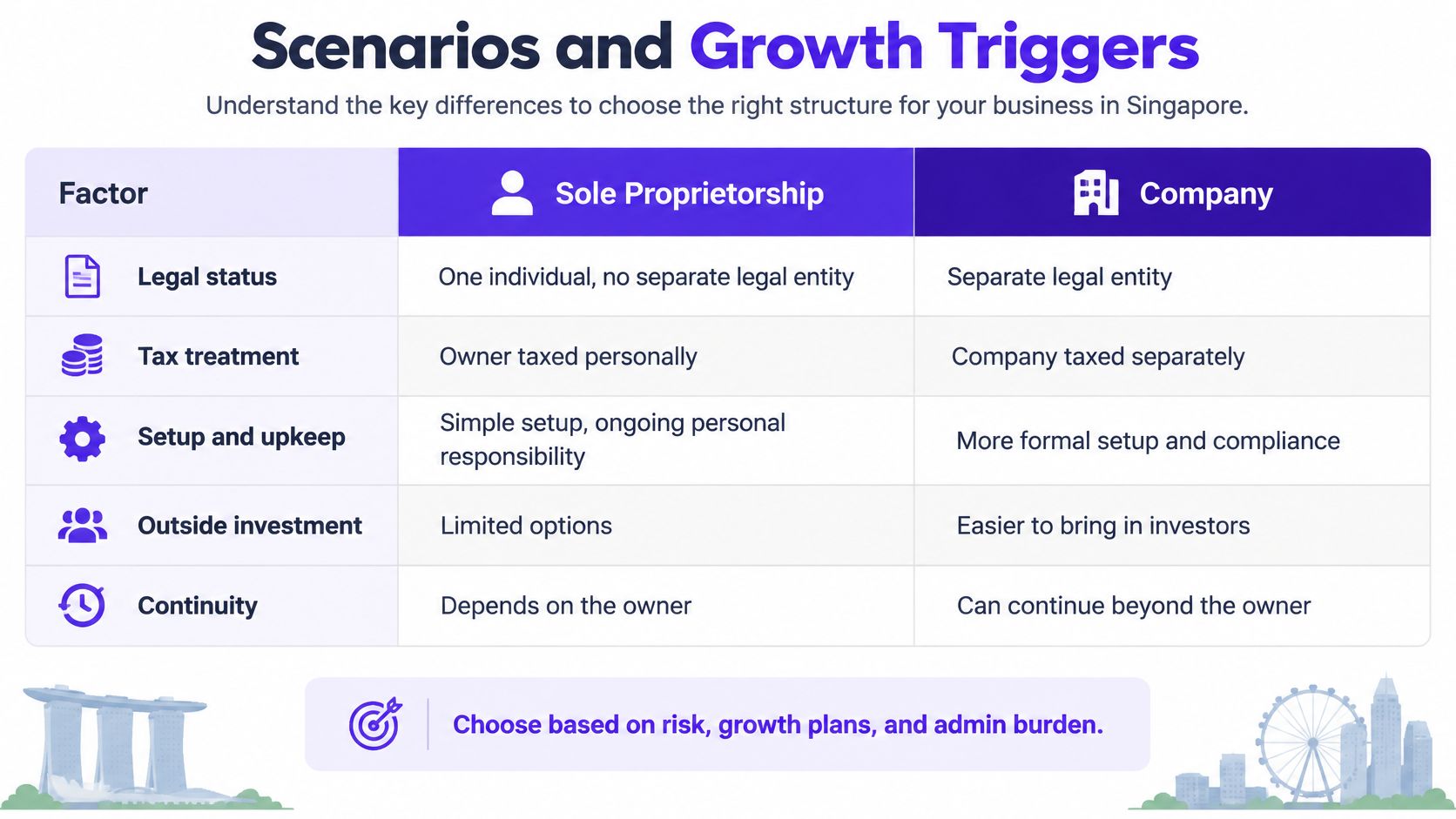
| Criterion | Sole proprietorship | Company |
|---|---|---|
| Legal status | Not separate from the owner | Separate legal person from its owners |
| Liability for debts | Owner personally liable | Generally limited to company assets, unless personal guarantees are given |
| Tax treatment | Business profit taxed as personal income | Company profit taxed at company level, with dividends generally not taxed again in Singapore |
| Setup and upkeep | Simpler, lower fees and admin | Higher setup and annual compliance requirements |
| Outside investors | Difficult, as the owner funds the business | Can issue shares to investors |
| Continuity | Ends when the owner stops | Continues beyond any one owner |
A sole proprietorship often suits a one-person, low-risk service business. Short contracts, modest invoices, no need for outside money. A photographer who shoots weekend events, and who can absorb a cancelled booking, sits comfortably in that group.
A company is worth testing when the facts change:
- Staff. You are about to hire, and employer duties will sit alongside your own tax and MediSave.
- Larger clients. Corporate customers ask for a company on the invoice, or their procurement team will not contract with an individual.
- High-risk paper. A lease, a supply contract or a client agreement asks you to guarantee the debt personally, so the company shield would be thin anyway until you negotiate that clause.
- Outside money. An investor wants shares, which a sole proprietorship cannot issue.
If you are weighing a middle path with more than one owner, our guide to a limited liability partnership in Singapore sets out how that structure differs.
Digital invoicing on the horizon
GST InvoiceNow requirements are being phased in on a published schedule rather than applying to every business at once. Under the phased timetable published by IRAS), all new voluntary GST registrants must transmit invoice data to IRAS through the InvoiceNow network from 1 April 2026 regardless of business structure, with new compulsory GST registrants scheduled to follow from 1 April 2028 and existing GST-registered businesses with annual supplies up to S$1 million scheduled to follow from 1 April 2029.
Each milestone applies to a specific group, so the dates shape planning now and filings later. For a sole proprietor the practical question is narrow. Once your turnover makes compulsory GST registration likely, your invoicing will need to send data to IRAS, and that obligation applies whether you stay unincorporated or set up a company. Structure changes what sits between you and the debt. It does not change the invoicing duty.
A company carries its own filings and costs, so the switch only pays when it buys something specific: separating liability, taking on investors, continuing beyond one owner, or signing larger commercial contracts. Three questions sort most cases. How much personal exposure can you accept on a bad job? Do you need outside money? Will your clients expect a company on the contract? If the first answer is "very little" and the other two are "yes", the registration form is no longer the decision.
Confirm Your Obligations and Next Steps
A sole proprietorship may be inexpensive to start, but its recurring duties still need regular attention. Before registering, ask whether the activity is low-risk and run by you alone, whether revenue is approaching a tax or GST threshold that will be difficult to monitor, and whether you can keep up with renewal, tax and MediSave obligations.
Where to confirm the facts
ACRA records are the authoritative source for business registration status. The Lawyer Guide's directory is not an official register and may not always be complete or up to date. Check the current position with the relevant Singapore authorities, including Bizfile and IRAS, before acting on a profile or screenshot.
Register now if the business is low-risk, owner-run and manageable with the compliance calendar you have in place. If clients, contracts or staffing plans are changing, set a date to review the structure. Those growth triggers may matter more than the initial registration fee.
The Lawyer Guide Singapore helps people discover, compare and contact lawyers and law practices using information about their practice, experience and client feedback. Advice comes directly from the lawyer you contact, not the platform. If a contract, guarantee or filing question needs a practitioner, browse the Singapore lawyer directory. This article is informative only and does not represent legal advice.
If your question has become a contract, personal guarantee or dispute, contact a lawyer directly through The Lawyer Guide.