Limited Liability Partnership LLP in Singapore
A limited liability partnership LLP guide for Singapore covering liability, tax, annual declarations and how it differs from a company.
You and another designer are ready to share clients, rent a studio and put a common name on your invoices. You don't want every business debt tied to your personal names, but you're not planning to build a company with shareholders either. A limited liability partnership sounds promising. The harder question is whether you're prepared for what happens when cash runs short or a partner leaves.
What a Limited Liability Partnership Means Here
A limited liability partnership (LLP) is a Singapore business registered with the Accounting and Corporate Regulatory Authority (ACRA). Under the Limited Liability Partnerships Act 2005, any two or more persons associated to carry on a lawful business for profit may register an LLP if they meet the statutory requirements.
Think of the LLP as a workshop. The workshop has its own name, property and contracts; the partners are the people who run it. For the designers, that means organising the studio's business around a registered entity rather than agreeing to work together.
Starting point: An LLP is a legal structure with continuing duties, not a label you can add to a partnership agreement.
Registration brings responsibilities, including having a manager and maintaining the records needed for ongoing compliance. Partners still need to decide who handles those tasks and who checks that they're done.
Where it sits among Singapore entities
ACRA's business registry covers six categories: companies, foreign companies, sole proprietorships, partnerships, limited partnerships and limited liability partnerships. An LLP sits alongside these alternatives; it isn't a type of private company.
This article is informative only and does not represent legal advice. Use the comparison below to shortlist a structure based on debts, tax and ownership, rather than choosing by name alone.
How an LLP Differs from Other Singapore Entities
Singapore entity comparison for founders choosing an LLP
| Entity | Separate legal person | Who meets business debts | Who is taxed on profits | Typical fit |
|---|---|---|---|---|
| Sole proprietorship | No | The owner personally | The owner | One-person trade with simple setup |
| Ordinary partnership | No | The partners, jointly and severally | Each partner on their share | Two or more people sharing a business without a separate entity |
| Limited partnership | No | General partner unlimited; limited partner generally limited to contribution if not managing | The partners | Venture with passive limited partners and at least one managing general partner |
| Limited liability partnership | Yes | The LLP from its own property; a partner is not liable merely for being a partner | Each partner on their allocated share | Professional firms and joint ventures wanting a separate entity without company tax |
| Private company | Yes | The company; shareholders generally limited to unpaid share capital | The company on its profits | Growth, retained profits, employees and outside investors |
Scan separate legal personality, who pays business debts, and who is taxed. These columns answer different questions, so don't assume that a separate legal entity must also pay income tax itself.
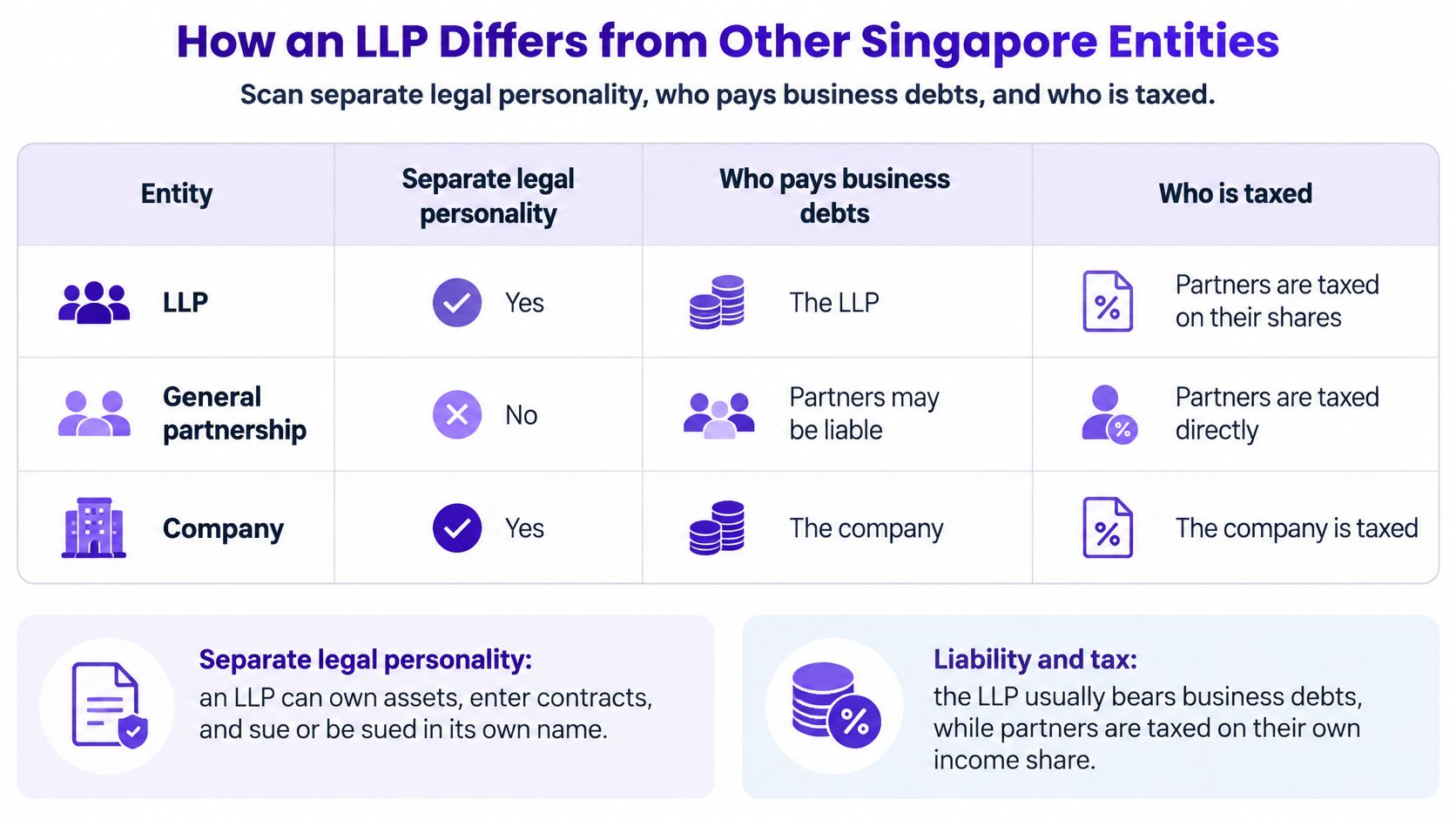
Separate legal personality: an LLP can own assets, enter contracts, and sue or be sued in its own name.
Liability and tax: the LLP usually bears business debts, while partners are taxed on their own income share.
Structures without a separate legal person
A sole proprietorship doesn't separate the owner from the business. It can suit someone trading alone, but a business creditor's claim isn't confined to a distinct entity's assets.
An ordinary partnership lets people pool their work and resources without creating a separate legal person. Joint and several liability means a creditor may pursue a partner for the whole partnership debt, leaving the partners to resolve contributions between themselves.
A limited partnership separates managing and passive roles. The general partner accepts unlimited liability, while a limited partner's protection rests on remaining outside management.
That makes it a different proposition from colleagues jointly running a studio or consultancy. Someone who wants an active say in everyday operations shouldn't treat passive-investor protection as interchangeable with LLP protection.
Structures with a separate legal person
An LLP suits partners who want to operate through a distinct entity while allocating taxable profits between themselves. Its flexibility is most useful when the partners have a clear agreement about work, money and decisions.
A private company is organised around shares. It is often a more natural starting point when founders expect outside equity investment, employee share options or profits retained within a company-tax framework.
An LLP doesn't issue shares. If your business plan relies on giving investors an equity stake through shares, don't leave the structure discussion until an investor is ready to sign.
The most easily misunderstood cells are partner liability and partner-level tax. Neither means the partners can ignore what they personally do or what income is allocated to them.
How to Register a Singapore LLP
Treat registration as setting up a working organisation, not merely obtaining a business name.
Put the operating arrangements in place
Choose the partners. Confirm the founding partners and their commitment to remaining involved. Don't build the venture around an indefinite solo arrangement if someone expects to leave soon.
Check the name. Search ACRA's business registry for availability. Avoid names identical or too close to existing entities, and don't commit to signage before the name is cleared.
Appoint a manager. Identify who will carry the LLP's continuing duties, including responsibility for the annual declaration. Make sure that person can obtain financial information from the partners.
Fix the registered office. Arrange a Singapore address where official notices will be received and dealt with.
Sign a partner agreement. Record capital contributions, profit-sharing ratios, decision rights and departure arrangements. Include a practical way to resolve deadlocks and settle an outgoing partner's account.
Lodge the registration with ACRA. Check the current requirements and fee schedule on ACRA's website before paying. Review the submitted particulars carefully.
Diary the first annual declaration. Set the deadline from registration using the filing calendar below, and assign someone to prepare the supporting accounts.
Before filing: Agree who supplies information, who approves it and who submits it. An unnamed shared responsibility is easy to overlook.
These steps are a general outline. Check current ACRA requirements before filing; specific registration or partnership-agreement questions may need a Singapore lawyer.
Which Debts the LLP Shield Actually Covers
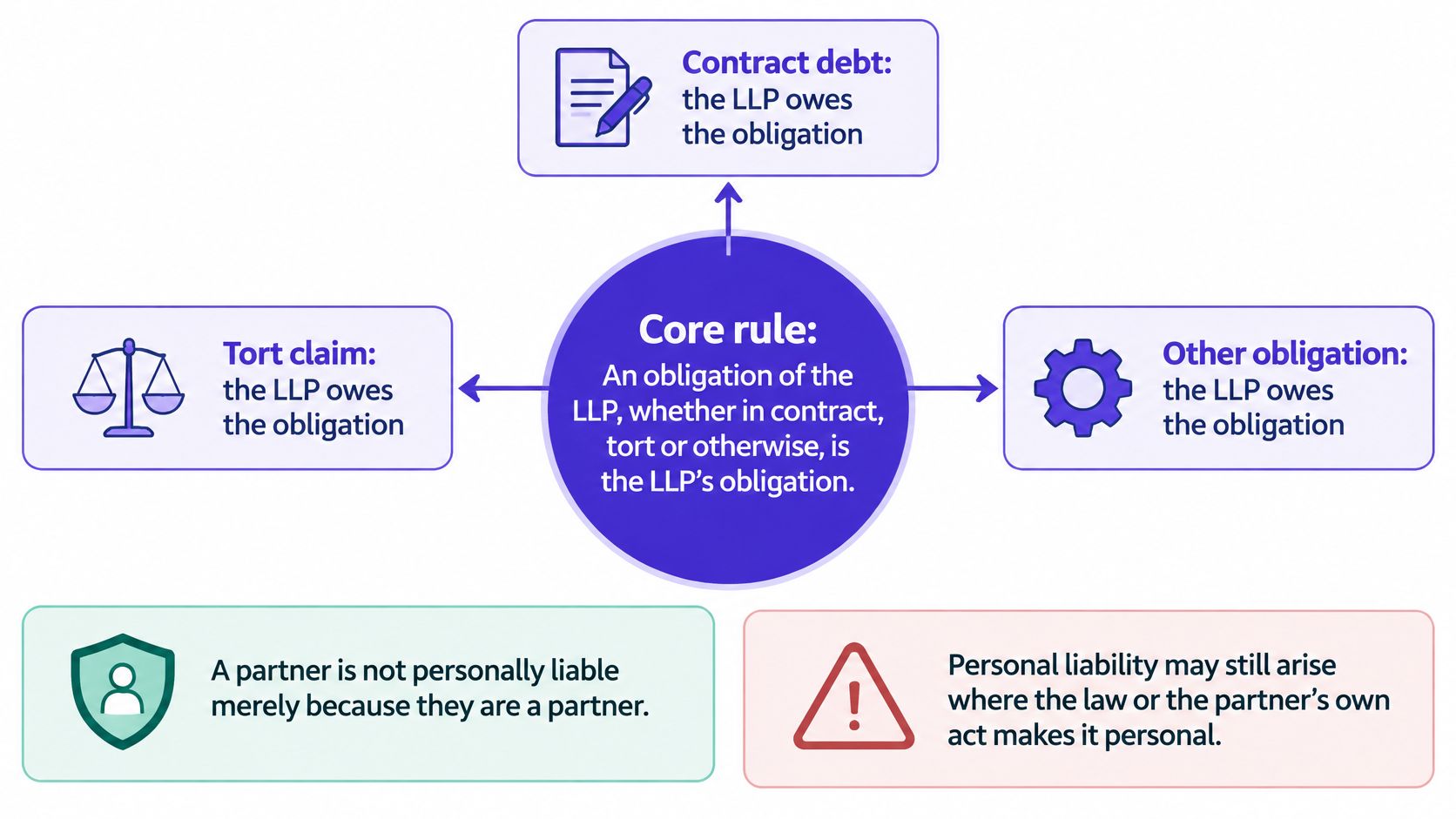
The core rule concerns whose obligation a debt is. Under Singapore's Limited Liability Partnerships Act, an obligation arising in contract, tort or otherwise is solely the LLP's obligation, its liabilities are satisfied from LLP property, and a partner isn't personally liable merely because they're a partner.
The shield protects partnership status, not personal conduct.
That distinction matters more than the words limited liability on a letterhead. It separates being connected to a business from being personally responsible for something you did.
An ordinary business debt
Say a professional consultancy engages a supplier in the LLP's name. The supplier performs the agreed work, but the consultancy doesn't pay the invoice. The starting point is a debt owed by the LLP, not a personal debt automatically owed by every partner.
Read the actual contract, however. A document signed by a partner on behalf of the LLP isn't the same thing as a separate personal undertaking by that partner.
Before signing a lease or major purchase agreement, check:
- The named customer: Does the document identify the LLP correctly?
- The signature capacity: Is the person signing for the LLP or personally?
- Additional commitments: Has anyone been asked to assume an obligation outside the LLP's own promise?
The structure doesn't replace careful contracting. Partners should understand the obligations they're creating before relying on the entity's protection.
A partner's wrongful act
The position changes when a partner personally commits a wrongful act or omission. If it happens in the ordinary course of the LLP's business or with its authority, the LLP is liable to the same extent as that partner; the partner's own exposure arises from the conduct, not just their membership.
For a professional firm, negligent advice therefore needs a different analysis from an unpaid stationery invoice. Fraud or another personal wrong cannot safely be dismissed as only the firm's problem.
An LLP profile must not suggest that registration wipes out personal liability for professional negligence or fraud. Clients assessing a lawyer should separately consider the individual's regulatory status, professional indemnity arrangements and engagement terms.
For partners, the practical response is to organise supervision, file handling and insurance around the work performed. Check who is insured, what activities are covered and how a potential claim must be reported.
This is general information, not a ruling on any particular claim. Legal personality, liability and income tax are distinct questions, even when they concern the same firm.
How IRAS Taxes LLP Profits and Losses
A separate legal person can still be fiscally transparent. IRAS's guidance on partnerships treats an LLP as a partnership for income tax: the LLP itself isn't taxed on its profits, each partner is assessed on their allocated share, and relevant deductions together with accumulated past relevant deductions cannot exceed that partner's contributed capital at the end of the relevant basis period.
An individual partner's allocation is taxed at individual income-tax rates. A corporate partner's allocation is taxed at corporate rates. The partner's identity therefore matters even though the underlying business is the same.
Follow the allocation rather than the bank balance
For a hypothetical example, suppose an LLP earns $200,000 in profit and the partners agree a 60/40 split. The LLP doesn't pay entity-level income tax on that profit; the allocations are $120,000 and $80,000, which the respective partners report.
Those figures illustrate allocation, not the final tax bill. Each partner's tax position still requires the appropriate adjustments and treatment.
Don't assume that leaving money in the LLP's bank account automatically prevents a partner-level tax assessment. Plan cash withdrawals and tax funding together, so a partner isn't allocated income without understanding how they'll meet the resulting liability.
Losses have a capital-based restriction
Losses and capital allowances need more attention than a profit-sharing percentage. A partner can't assume that every allocated deduction is immediately usable against their other income.
The contributed-capital restriction means nominal capital contributions can limit the practical tax benefit of a loss-making period. Changing the profit split may change allocations, but it doesn't by itself remove the capital restriction or alter the LLP's legal personality.
Keep a partner-by-partner record of:
- Contributions: Amounts contributed and the supporting documents.
- Allocations: The agreed basis for sharing profits and losses.
- Deductions: Losses, capital allowances and accumulated relevant deductions.
- Changes: Admissions, departures and amendments to the sharing agreement.
The managing partner should ensure that each partner's contributions are reported when applying the deduction restriction. That responsibility calls for reconciled records, not an estimate assembled when a return is due.
Tax transparency is useful only if the partners understand how allocated income and restricted deductions fit their own tax positions. Compare the expected outcome for the actual partners, rather than assuming partnership taxation is automatically cheaper.
Filing the Annual Solvency Declaration on Time
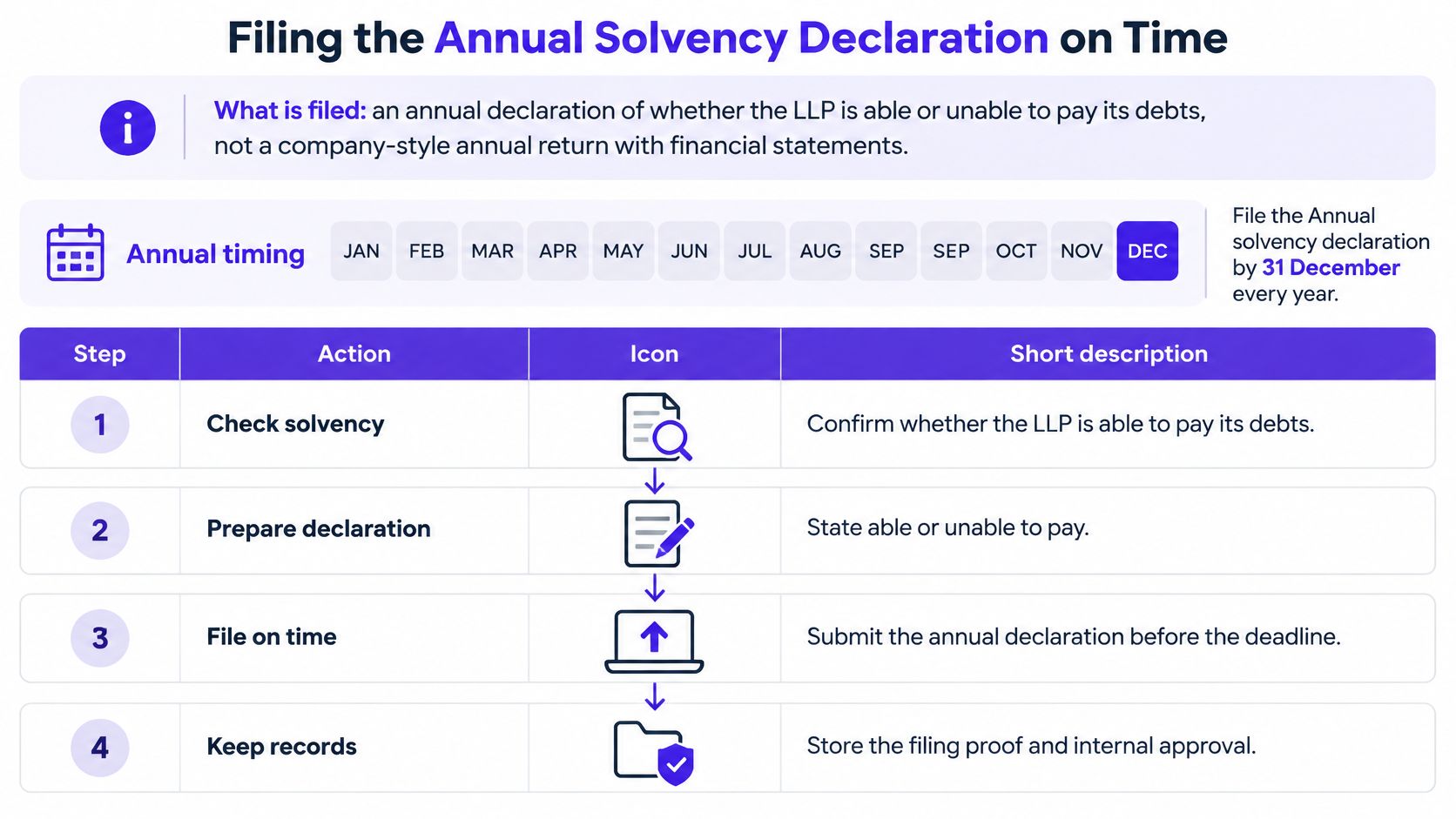
An LLP files an annual declaration stating whether it is able or unable to pay its debts, not a company-style annual return with financial statements. ACRA's annual-declaration deadline guidance sets the first deadline at within 15 months of registration, later deadlines at once every calendar year and no more than 15 months after the previous declaration, the filing fee at $30, late penalties at up to $600, and a pre-deadline extension application at $200, non-refundable, with processing that may take up to 14 working days.
Singapore LLP annual declaration dates and fees
| Item | Rule | Amount or timing |
|---|---|---|
| First declaration | Due after registration | Within 15 months of registration |
| Later declarations | Recurring deadline | Once every calendar year and no more than 15 months after the previous declaration |
| Filing fee | Payable on lodgement | $30 |
| Late filing | Penalty range under ACRA deadline guidance | Up to $600 |
| Extension of time | Must be applied for before the deadline | $200, non-refundable, and may take up to 14 working days |
| Unable to pay debts | Declaration content | State inability; do not treat the form as a routine checkbox |
The recurring deadline has both a calendar-year requirement and an elapsed-time limit. Don't just copy the last filing date into a reminder and assume that's enough.
If the LLP can pay its debts
A solvent LLP still needs a basis for its declaration. The manager should review proper accounts, available cash, upcoming payments and the collectability of unpaid invoices.
A healthy sales pipeline isn't the same as money available to pay creditors. Resolve unexplained balances and ask the partners about commitments that haven't yet reached the bookkeeping records.
Keep the financial review and internal approval with the filing confirmation. This makes the next review easier and records why the declaration was made.
If the LLP cannot pay its debts
Declare the inability clearly. Don't choose a favourable answer because you hope a customer will pay soon or because the partners are embarrassed about the position.
That status can affect creditor confidence and may signal a need for restructuring or insolvency advice. Prepare a creditor list, payment schedule, cash-flow forecast and details of disputed debts so an adviser can assess the situation.
Solvency check: Ask whether the LLP can meet its debts, not whether the partners believe the business will eventually recover.
An extension gives more time for filing if granted. It doesn't make the underlying financial problem disappear.
If the deadline is close or already missed
If more time is needed, apply before the deadline and allow for processing. Don't leave the application until the last moment and assume acceptance is automatic.
If the filing is already late, establish what remains outstanding and arrange prompt remediation. Check the applicable penalty position rather than assuming that lodging the declaration removes every consequence.
The manager needs proper accounts to support this process, even though financial statements aren't attached as a company-style annual return. This article is informative and does not represent legal advice on a distressed LLP.
- Know the due date: Record it and assign a responsible person.
- Decide: Establish whether the LLP is able or unable to pay its debts.
- Apply early: Request more time before the deadline if needed.
Singapore Setups That Test the LLP Rules
An entity choice becomes clearer when you test it against a change in the business, not just the day it opens. These scenarios show where partners need to make an active decision.
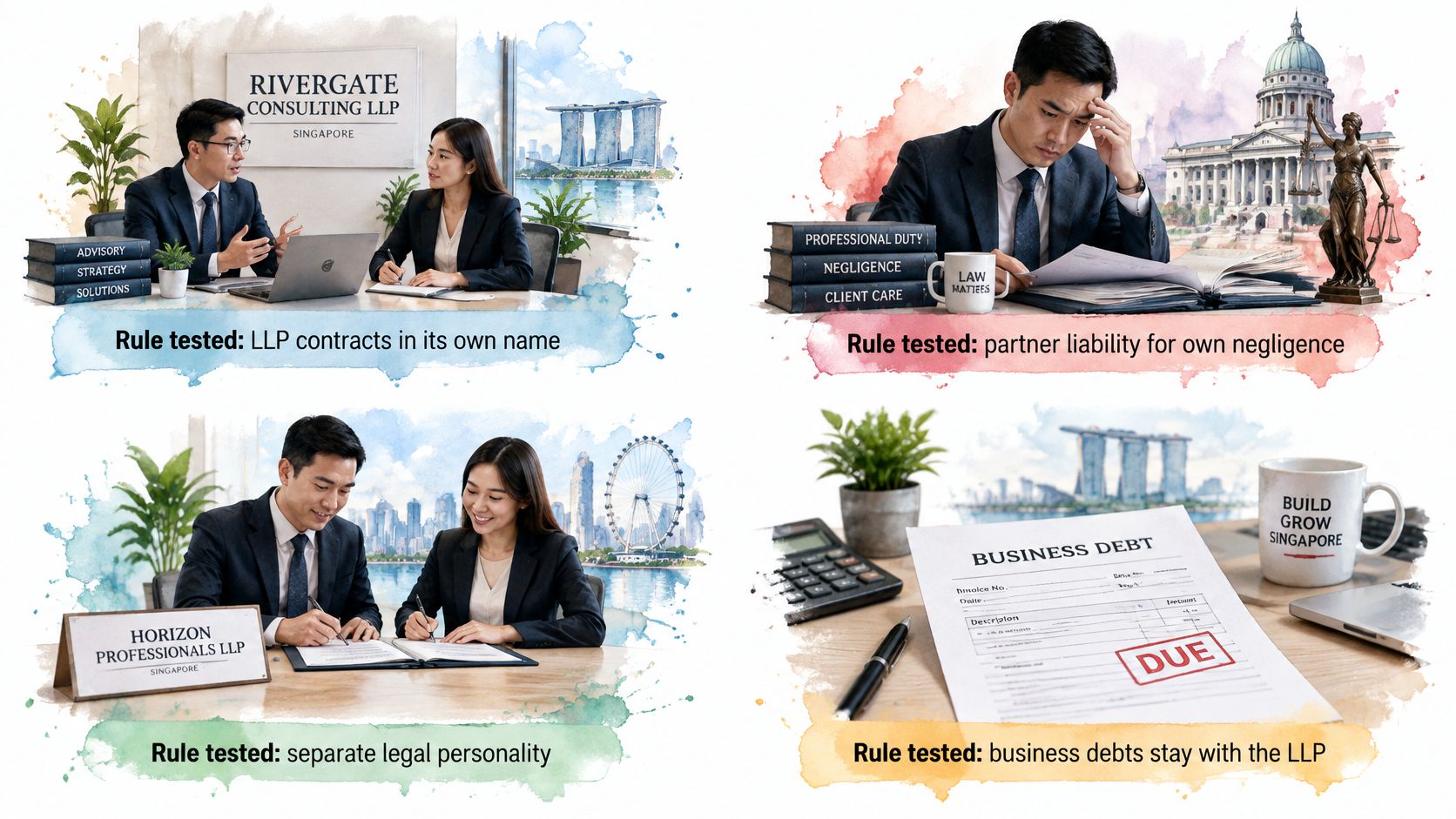
Professionals sharing a brand
Advocates or consultants want a common brand, shared premises and central billing. They organise contracts through the LLP, but each matter still needs a clearly identified professional responsible for the work.
If a client alleges negligent advice, the useful documents are the engagement letter, working file and insurance policy, not just the registration record. The test is whether operational responsibility matches the work and its risks.
A studio preparing for investment
A creative studio starts with partners who want to divide current earnings. Later, an investor asks for shares and an employee asks about equity incentives.
Before promising either, the partners need a company-structure or conversion conversation, including the treatment of contracts, assets and tax. The test is whether the intended ownership arrangement can actually be delivered through the chosen entity.
A partner resigns
A departure can leave the remaining partner managing clients while postponing the search for a replacement. That's dangerous if temporary arrangements become the permanent business model.
ACRA's LLP common-offences guidance states that an LLP may operate with one partner for up to two years, but continuing beyond that period exposes the remaining partner to personal liability.
Record the departure date, review the agreement and decide promptly whether to admit someone or seek advice on another structure. The test is a compliance clock, not a permanent exemption for a solo business.
A working partner's CPF position
A partner receives regular payments and works within the firm, but the word partner doesn't settle CPF treatment. The Central Provident Fund Board's LLP guidance says CPF contributions are payable for a partner employed under a contract of service, while a self-employed person with annual net trade income exceeding S$6,000 must make compulsory MediSave contributions.
A partner employed under a contract of service is treated as an employee for CPF purposes. Without that employment relationship, the partner is generally treated as self-employed.
Examine the actual contract, duties and income records instead of relying on the title or payment description. The test is the working relationship, not the label.
These cases are illustrations. This article does not represent legal advice or personalised CPF advice.
Decide If an LLP Fits Before You Register
An LLP deserves consideration when the partners want to run a business together through a distinct entity and accept the responsibilities that come with it. The decisive question isn't whether registration looks simple; it's whether the arrangement will still work when profits, cash flow or membership change.
A serious candidate
An LLP may fit where the partners expect to remain involved, are comfortable with partner-level taxation and can maintain reliable accounts. They should also be willing to appoint a manager, support honest solvency declarations and agree departure terms before anyone wants to leave.
Test the arrangement against practical questions:
- Continuity: Who takes action if a partner resigns or stops participating?
- Cash management: Who monitors debts and gives the manager accurate information?
- Ownership plans: Are the founders expecting investment through shares?
- Professional risk: Who reviews insurance and responsibility for client work?
A weak fit or the wrong reassurance
A solo founder, a venture seeking share-based equity or owners who want the firm itself to be the taxpayer should examine alternatives. An LLP is also the wrong reassurance when the main concern is personal negligence; choosing an entity doesn't replace competent work and appropriate protection.
This article is informative only and does not represent legal advice. For a specific formation, partner agreement, insolvency declaration or professional-practice question, consult a Singapore lawyer handling company formation or commercial work.
The Lawyer Guide is a directory and referral platform, not a law firm. We don't supervise lawyers, control their advice, set their professional fees or take part in the lawyer-client relationship.
Submitting a legal help request doesn't create a lawyer-client relationship with us or any lawyer. That relationship begins only if a lawyer separately accepts the engagement; offers users receive are free and don't bind them to appoint those lawyers.
For a useful initial enquiry, describe the proposed partners, the business activity and any expected departure during the early years. Include the issue you need resolved, rather than asking only whether an LLP is generally a good idea.
Visit The Lawyer Guide to search and compare Singapore lawyers or send a legal help request about your proposed LLP. Describe your ownership plans, partner arrangements and any solvency concerns so participating lawyers can consider the relevant question before you decide whom to engage.