Joint Custody Shared Custody: What Singapore Law Means
Joint custody shared custody in Singapore explained: how decisions, care and control differ, with court figures. General information, not legal advice.

About 74.3% of custody orders in 2016 were joint-custody orders, representing 2,940 orders, according to government figures reported by Mothership. That majority outcome doesn't establish that children divided their time equally between their parents. It describes shared authority over important decisions, not a particular sleeping arrangement.
For parents comparing joint custody, shared custody and parenting schedules in Singapore, the useful questions are concrete: Who decides? Who provides everyday care? Where does the child sleep? Those questions reveal more about an arrangement than its informal label.
Joint Custody and Shared Care at a Glance
Shared care and control was ordered in 5.6% of civil divorces in 2016, rising to 9.5% by 2020, according to the High Court Family Division judgment that compiled those figures. Shared physical care remained the exception even as it grew. That gap between a common custody outcome and a rare residential one is why the exact terms of an order carry more information than its label.
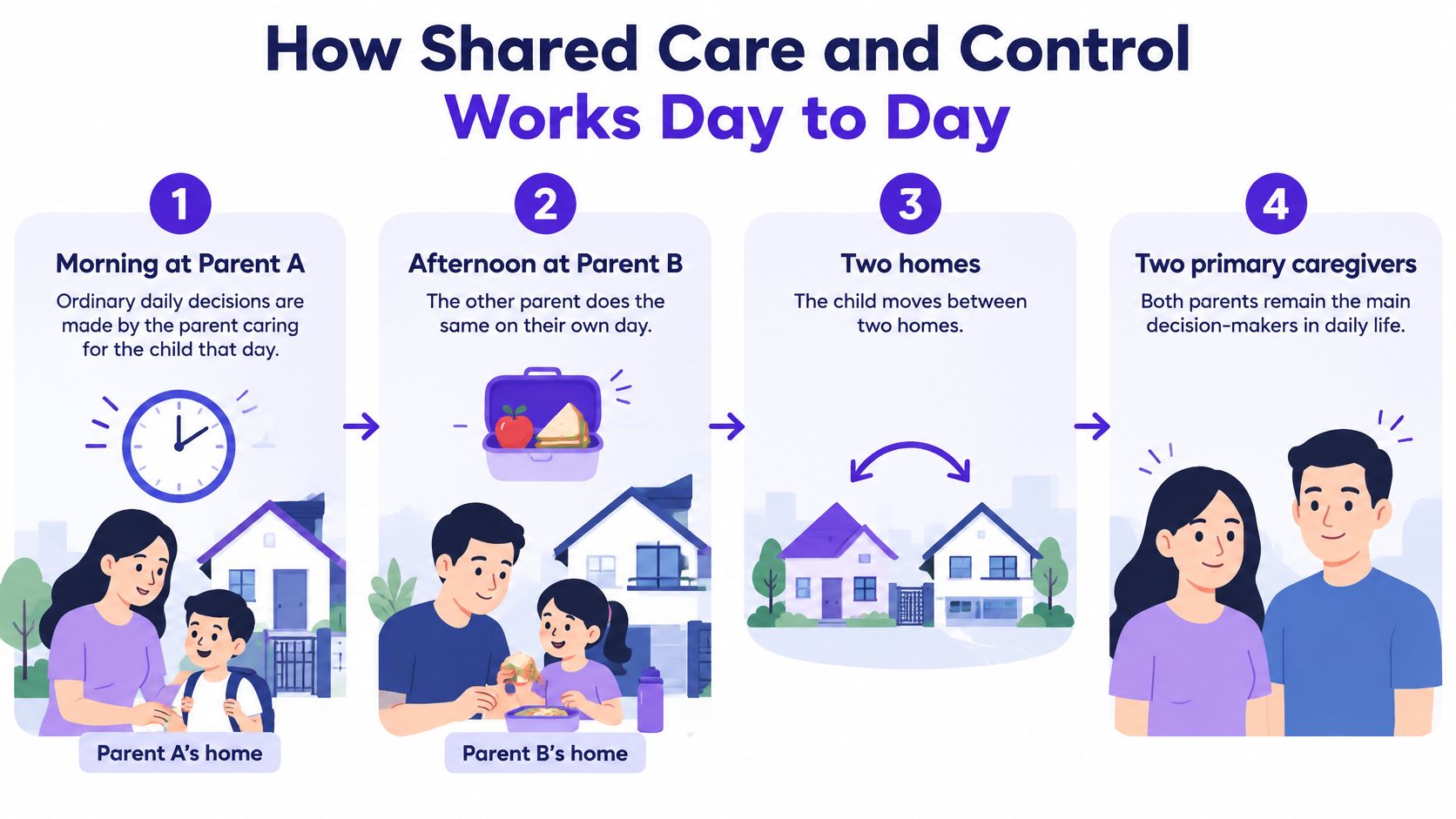
The High Court Family Division's decision on shared care and control distinguishes major decision-making from physical living arrangements. Under shared care, each parent generally handles ordinary daily decisions while the child resides with them, giving the child two homes and two primary caregivers. Reading the two questions separately matters whether you are negotiating an agreement, checking an existing order or considering a change.
Joint custody and shared care and control compared
| Feature | Joint custody | Shared care and control |
|---|---|---|
| Main question answered | Who makes major decisions for the child? | Where does the child live, and who handles daily care? |
| Decisions covered | Education, religion and significant healthcare | Everyday matters such as meals, clothing and routine |
| Implied time split | None; doesn't by itself mean equal time | Substantial, sometimes broadly comparable periods with each parent |
| Child's homes | Usually one primary residence under the separate care-and-control arrangement | Two homes |
| What the published figures count | Custody orders made, whatever schedule the child follows | Civil divorces in which shared care and control was ordered |
The two series count different groups. A custody order sits above whatever residential schedule the parents follow, so the proportion of custody orders made on joint terms says nothing about how many children had two homes. The shared-care series counts a living arrangement; the custody series counts decision-making authority.
Read the order, not the shorthand
A parent can share responsibility for school choice without collecting the child from school on alternate days. Equally, an extensive residential schedule needs clear arrangements for ordinary caregiving, not just agreement on long-term matters.
Practical rule: A joint-custody clause isn't a timetable. Look separately for the provisions governing residence, handovers and access.
The phrase shared custody can obscure that separation when parents use it informally. Ask whether it refers to shared decisions, shared physical care or both before accepting it as a description of your arrangement.
This article is general information only and does not constitute legal advice. A family lawyer should confirm the meaning and effect of the terms in your specific order.
What Joint Custody Means Under Singapore Law
Custody concerns major, long-term decisions affecting the child. Care and control concerns the child's primary living arrangements and everyday decisions. Access describes the periods a parent without care and control spends with the child.
The Family Justice Courts' explanation of TAU v TAT distinguishes these responsibilities and identifies the child's welfare as the paramount consideration when deciding custody, care and control, and access. That welfare focus prevents the terminology from becoming a contest over which parent receives the more favourable label.
Long-term authority and daily responsibility
School selection, religious upbringing and significant healthcare belong to a different category from choosing dinner or clothing. A disagreement about transferring schools therefore raises a different issue from disagreement about the evening routine in a parent's home.
In CX v CY, the Court of Appeal treated joint or no custody as the usual position, with sole custody an exception, and distinguished long-term decision-making from daily care. The court also explained that a parent's fear of future disagreement doesn't necessarily prevent joint custody, because such an order can support continued joint parenting.
That reasoning doesn't mean cooperation can be assumed. Parents still need a practical method for exchanging information, putting forward proposals and addressing disagreements without allowing school or healthcare decisions to drift.
The statutory framework
Under the Guardianship of Infants Act 1934, either parent or an appointed guardian may apply for orders concerning custody, access and maintenance, and the court may alter, vary or discharge an existing order when circumstances justify doing so. The existence of that power doesn't mean a parent can rewrite an order when the arrangement becomes inconvenient.
Before interpreting your own paperwork, make a short inventory:
- Custody: Identify who has responsibility for major decisions and any specific decision-making directions.
- Care and control: Identify who provides the child's residential base or whether care is shared.
- Access: Identify the other parent's periods with the child, including any conditions attached.
Keep the wording intact when making that inventory. Replacing a precise clause with an informal summary can hide an important qualification, such as a specified exchange location or a separate holiday arrangement.
How Shared Care and Control Works Day to Day
Shared care and control must work as a caregiving arrangement, not merely a division of calendar space. Each home needs a parent who can manage school preparation, meals, bedtime and the ordinary decisions that arise while the child is there.
The Family Justice Courts' decision in TAU v TAT describes arrangements ranging from approximately three days with one parent and four with the other to roughly equal overnight time, without a fixed presumption for or against shared care. The controlling assessment concerns the child's welfare, including developmental needs, relationships, parental cooperation, age and personality.
Test a week before proposing it
Consider this illustrative schedule, rather than a recommended or court-prescribed pattern:
- Monday to Wednesday begins with Parent A. Parent A handles Monday and Tuesday nights, Wednesday morning preparation and school drop-off. Parent B collects the child from school on Wednesday, so Wednesday night belongs to Parent B's period.
- Thursday to Sunday continues with Parent B. Parent B manages those school days and the weekend, then returns the child after dinner on Sunday. Parent A resumes responsibility that evening.
- Allocate the work within each period. The caring parent handles meals and bedtime. Routine school forms go to the parent responsible for the deadline, while forms involving a major educational choice require the appropriate joint decision.
This exercise exposes ambiguity. Saying Monday to Wednesday with one parent and Thursday to Sunday with the other leaves Wednesday night unclear unless the handover time is specified.
The official Family Orders Guide approach described in the statutory materials is similarly practical: a shared-care order specifies the days and times during which the child resides with each parent. A usable proposal should be equally clear.
Check whether the child can manage the arrangement
Don't stop at whether both adults accept the calendar. Ask whether the child can maintain sleep, school attendance, friendships and a manageable routine across both homes.
- Commutes: Test the school journey from each address during the actual travel period.
- School and childcare: Identify who collects the child when school closes early or childcare isn't available.
- Enrichment classes: Allocate transport, equipment and collection responsibility.
- Religious holidays: Specify how special occasions interact with the ordinary calendar.
- Housing: Check sleeping space, school materials and access to necessary belongings.
Where parents want help discussing transitions or communication, Interactive Counselling's support for parents and children is a counselling resource, not a source of Singapore legal advice. Emotional support and legal clarification address different needs.
Where Joint Custody and Shared Care Overlap
The combinations below separate major decisions, daily decisions and residence. Each row describes a possible structure, not a promise that a court will make that order for a particular family.
Common combinations of decision-making and residence
| Arrangement | Major decisions | Daily decisions | Child's living pattern | Typical example |
|---|---|---|---|---|
| Joint custody with primary care to one parent | Both parents | Parent with care and control | One main home with regular access for the other parent | Parents share schooling and healthcare choices while the child lives mainly with one parent |
| Joint custody with shared care and control | Both parents | Each parent while the child is with them | Two homes with specified residential periods | An illustrative alternating-week schedule, with provisions for illness and holidays |
| Sole custody with access | One parent | Parent with care and control | One main home with access to the other parent | An illustrative arrangement involving set weekends and school holidays |
Read across a row rather than down a single column. Two arrangements can allocate major decisions identically while imposing very different school-day, transport and overnight responsibilities.
Sole custody and sole care and control also shouldn't be treated as interchangeable. A description of who provides daily care doesn't, by itself, establish who holds authority over major decisions.
Equal time requires its own justification
The Family Court decision on equal weekly care illustrates that each parent can be allocated half of every week in an appropriate case, with flexibility for illness, childcare closures and holidays. That outcome demonstrates what a particular residential order can provide, not what the words joint custody automatically confer.
The distinction has a practical consequence during negotiation. If parents agree to joint custody but leave residence unresolved, they haven't necessarily agreed on the most demanding part of their weekly arrangements. Conversely, agreeing on nights doesn't settle how they will decide on a school transfer or significant treatment.
Shared responsibility should be described by the task being shared, not inferred from a label.
Questions that expose an incomplete proposal
Ask each parent to answer these questions against the actual calendar:
- Major decisions: Which choices require consultation, and how will proposals and responses be recorded?
- Overnight time: Where does the child sleep on ordinary school nights, weekends and holidays?
- School-day responsibility: Who handles transport, homework materials and unexpected collection?
- Disruptions: What happens during illness, childcare closures or a parent's necessary travel?
- Special occasions: How do religious holidays and family events affect the ordinary schedule?
A proposal that answers only the overnight question can still leave substantial work unallocated. For example, a parent may have the child overnight while relying on the other parent for every school collection. That isn't necessarily unworkable, but it should be explicit rather than discovered after the arrangement begins.
Which Arrangement Fits Which Family Situation
Feasibility is more useful than a preferred label. The High Court Family Division has described shared-care orders as exceptional and emphasised arrangements capable of supporting the child's welfare and workable co-parenting. The published increase in shared care doesn't establish a general entitlement to equal time.

Family situations and the arrangement to discuss first
| Situation | Arrangement to discuss first | What to document | Why it matters |
|---|---|---|---|
| Parents agree, live close and have similar working hours | Joint custody with shared care and control, if workable | Agreed weekly calendar and exchange times | Equal time must be feasible in practice |
| Parents live apart and one has limited schedule flexibility | Joint custody with primary care to one parent, plus access | Work rosters, travel plans and childcare arrangements | Stability and workable logistics may outweigh equal time |
| One parent is a Singapore citizen and the other a non-resident | Check the allocation of decisions, care and access before proposing a schedule | Residence status, travel records and relocation plans | Residence and travel constraints affect feasibility |
| Concerns about safety or unreasonable behaviour | Structured or supervised access may be relevant | Dated incident records and written messages | Safety concerns need separate assessment from ordinary scheduling disputes |
For cooperative parents living nearby, the most informative evidence is a calendar they can keep. Compatible working hours help only if someone remains responsible when a meeting runs late, the child falls ill or school arrangements change.
Where one parent has limited flexibility, begin by protecting the child's dependable routine. Work rosters and childcare bookings make the discussion more useful than competing assertions about who deserves more time.
Residence constraints and safety need different responses
Citizenship or non-resident status shouldn't be used as a shortcut to predict the outcome. Instead, establish where each parent can live, the travel involved and whether proposed relocation would undermine the calendar. Keep the question of major decision-making separate from those physical constraints.
Safety concerns require a different conversation from inconvenience or poor punctuality. Record specific conduct and seek advice about protective arrangements, rather than assuming that every communication disagreement calls for supervised access.
Decision check: A family can fit several rows at once. Use the table to organise the discussion, not to predict the court's decision.
If separation also raises questions about whether the marriage should be ended by divorce or annulment, the guide to annulment of marriage in Singapore addresses that separate issue. Don't let uncertainty about the marital process replace careful consideration of the child's immediate arrangements.
How Arrangements Change and When to Review Them
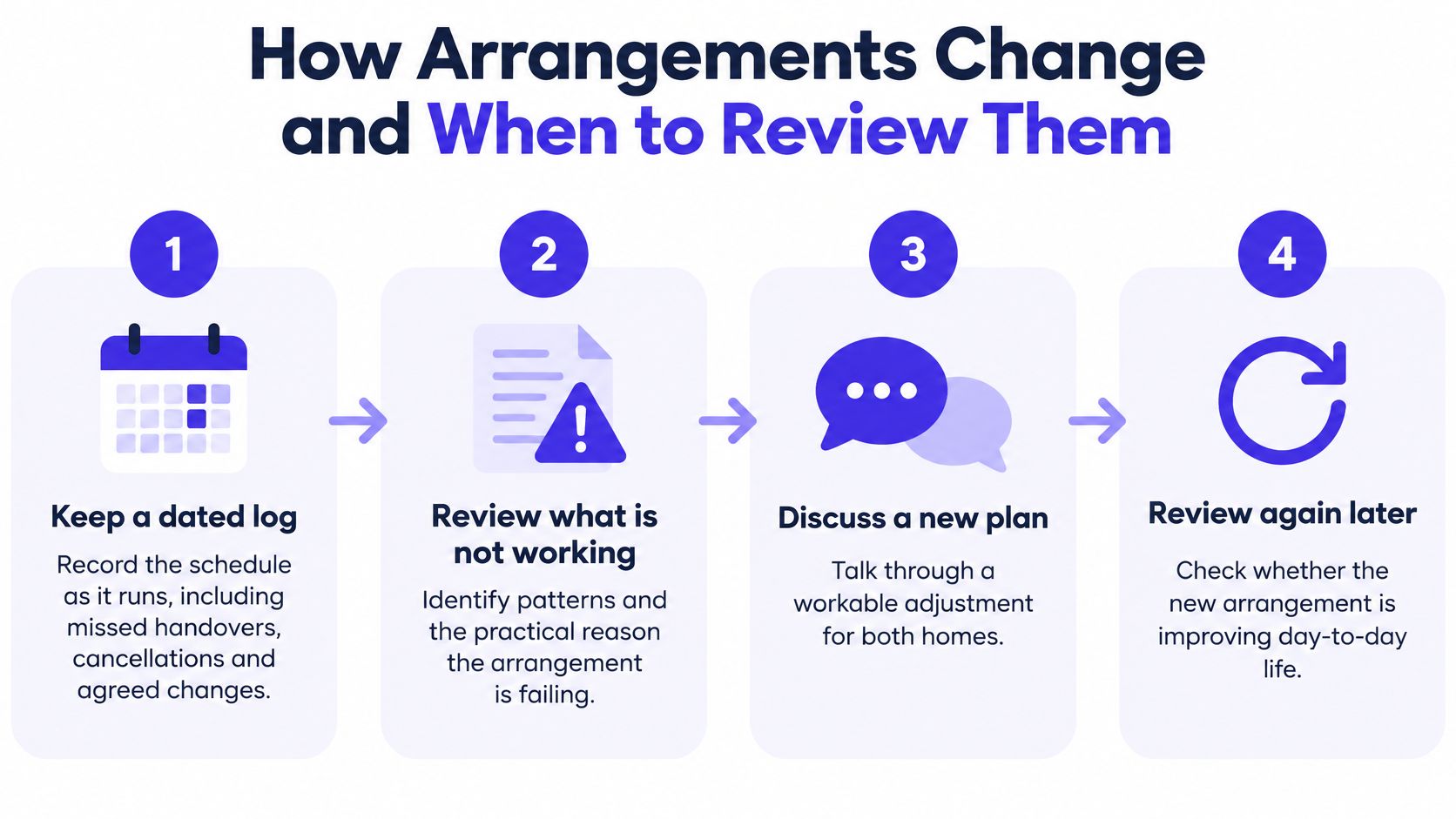
A workable arrangement can become difficult after a housing move, school transfer or change in working hours. The useful response is to identify what changed, how it affects the child and what adjustment would address it.
Build a record before proposing a change
- Keep a dated log. Record actual handovers, cancellations and agreed swaps. Separate what happened from your interpretation of the other parent's motives.
- Note the practical trigger. A new roster, longer commute, travel, illness or changing developmental needs may explain a pattern that a list of missed exchanges alone doesn't.
- Check the existing wording. Identify fixed days and times, holiday exceptions and general access provisions. Your preferred adjustment may affect more than the clause that first attracted attention.
- Put a proposed adjustment in writing where discussion is safe and appropriate. Record agreement clearly, but don't assume an informal agreement formally replaces the court order.
- Ask about a variation application. If cooperation breaks down or the change needs legal effect, obtain advice on whether a formal application is necessary under the court's statutory variation powers.
- Treat safety separately. Ask whether structured access or supervised exchanges are relevant rather than trying to solve a safety concern through calendar changes alone.
A useful log might record that a school collection failed, who collected the child instead and whether the child missed an activity. Keep the associated messages so the entry can be understood in context.
What changed arrangements can look like
The High Court Family Division's judgment concerning a long-running shared-care arrangement discusses a schedule following separate Singapore residences and maintains care and control with one parent while preserving the other's access; the decision also addresses another recent outcome involving sole care and control with liberal access. These outcomes undermine the assumption that an established equal-time pattern must continue indefinitely.
They don't establish that every disrupted schedule warrants the same response. A parent should explain why the proposed change addresses the child's needs, not present the other parent's failures as a tally.
General access wording can provide flexibility when parents cooperate and uncertainty when they don't. If you're unsure which professional handles a review, the guide to types of lawyers in Singapore can help you identify family-law expertise.
Confirm Your Custody Terms With a Family Lawyer
Confirm the legal effect of your existing terms before agreeing to a replacement schedule. Confirm that the decision-making responsibilities, residential periods and practical obligations are clear before accepting a proposal. A joint custody order settles who decides. It does not by itself settle who cares for the child day to day or where the child sleeps.
Bring the documents that allow a lawyer to compare the legal wording with daily life. A summary alone may omit an exception or condition that changes the advice.
Prepare a focused review
- Existing paperwork: Gather the court order, relevant agreements and any later orders.
- Proposed calendar: Show ordinary school days, weekends, holidays and exact exchange arrangements.
- Child's commitments: Include the school and activity calendar, transport needs and relevant care requirements.
- Actual experience: Bring the dated log and messages described above.
Ask the lawyer to classify each relevant clause as custody, care and control, access or a variation provision. Then ask whether the proposed change affects only scheduling or also alters responsibility for decisions and care.
Check whether the order specifies residential days and times or uses broader access wording. Ask how the proposed arrangement should be recorded and whether court approval or a formal application is needed, rather than relying on an assumption that written agreement settles every legal issue.
Choose relevant experience
A Singapore lawyer directory lets you compare legal professionals by expertise, location and profile information. Before engaging a lawyer, check their experience with children's arrangements, access disputes and variations, and consider client reviews alongside that experience.
The Lawyer Guide helps you find and contact lawyers who can clarify custody, care and control, access and proposed variations. For a referral request, choose the relevant legal category, such as Divorce & Separation, describe the matter and provide your contact details; the case is reviewed and forwarded to up to 3 lawyers matching the required expertise and location. Keep that description factual: identify the existing arrangement, the proposed change and the main difficulty, and include particular events only where they bear on the child's welfare or safety. Lawyers on the platform are bound by strict confidentiality rules, so case details cannot be shared publicly. The Lawyer Guide is a directory and referral platform, not a provider of legal advice: advice and representation come directly from the lawyers you contact. Visit The Lawyer Guide with your existing order and a clear description of the arrangement you want reviewed, so you can seek advice before committing to a new parenting schedule.