Singapore Lawyer Directory: How to Search and Compare
Use a Singapore lawyer directory to filter by practice area and location, then judge profiles and reviews before you contact a lawyer.

You've got a dismissal letter, a difficult family decision or a contract you're uneasy about signing. You open a Singapore lawyer directory and find pages of names, practice areas and ratings, but it's not obvious which details matter or who can help.
A useful search starts with your problem, not the highest-rated profile. The aim is to identify relevant lawyers, check their current professional position and make an enquiry that helps you compare the right things, without mistaking a directory listing for legal advice.
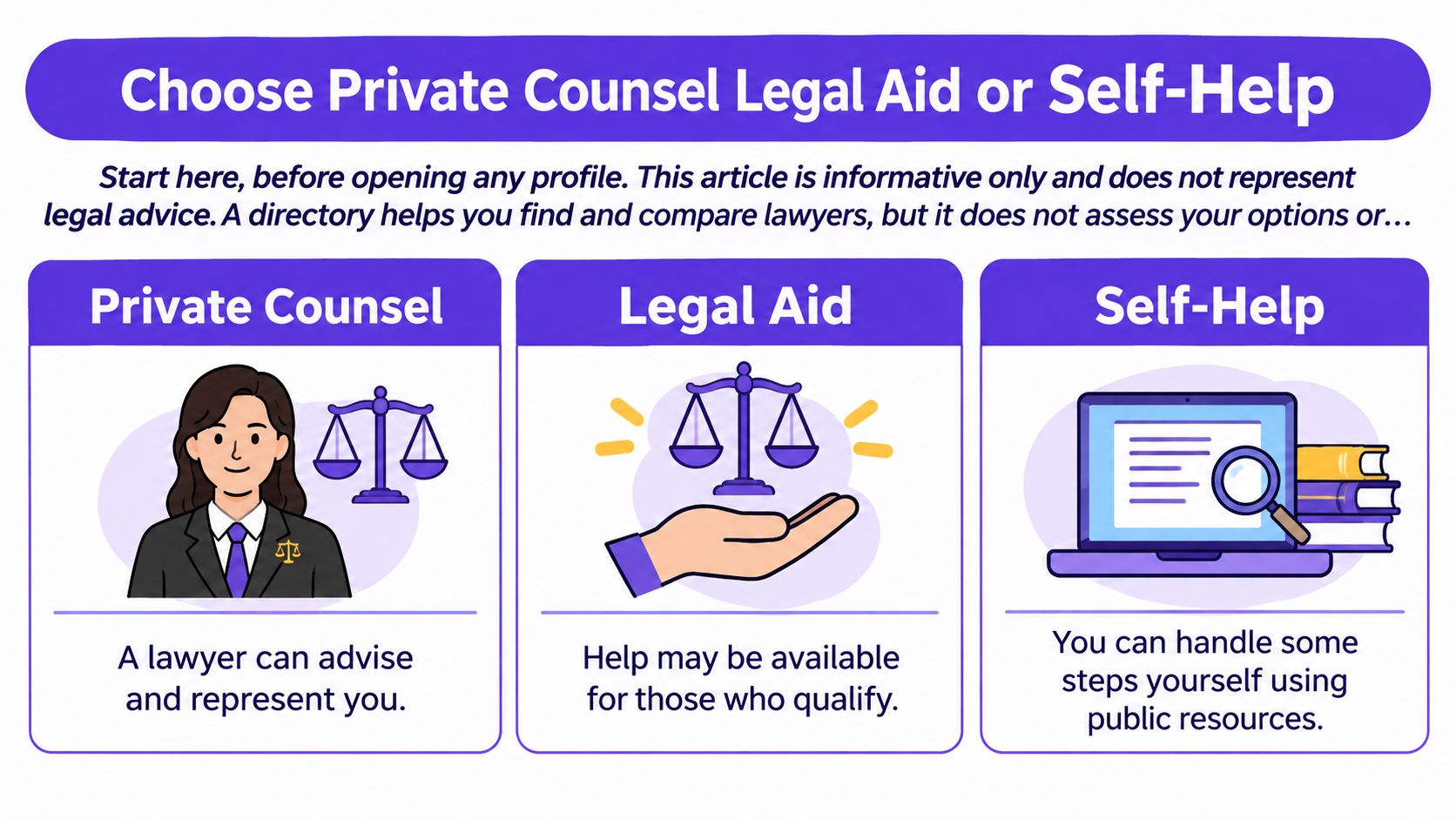
Choose Private Counsel Legal Aid or Self-Help
This article is informative only and does not represent legal advice. A directory helps you find and compare lawyers; it doesn't assess your legal options or create a solicitor-client relationship. Before opening a profile, consider whether private representation, legal assistance or self-help is the appropriate starting point.
Cost matters, but so does the work involved. Someone who needs a document explained faces a different decision from someone preparing to conduct a contested hearing.
Work through the practical questions
Start with whether you can pay for help throughout the matter, rather than only the opening consultation. If private counsel is realistic, a directory can help you identify lawyers to approach about scope and fees.
If your means are limited and the matter is civil, investigate legal assistance before committing to private fees. The Singapore Government Directory's Legal Aid Bureau entry describes assistance for persons of limited means, with services that can include oral advice, document drafting and representation in listed civil proceedings, including the Family Courts, Syariah Court and certain work-injury compensation proceedings before the Commissioner of Labour.
Eligibility isn't automatic. Ask the Bureau to assess your circumstances and the matter rather than assuming that limited income alone guarantees representation.
Private lawyer, legal aid and self-help
| Route | Fits when | What it can cover | Confirm before you rely on it |
|---|---|---|---|
| Private lawyer from a directory | You can pay for tailored help | Advice and representation agreed with that lawyer | Fees, conflicts and fit for the matter |
| Legal Aid Bureau | Means are limited and the matter is civil | Advice, drafting and representation in listed civil forums | Eligibility and merits with the Bureau |
| Representing yourself | The procedure is manageable | You run the case yourself | Time and ability to meet court rules |
Assess the work, not just the expense
Representing yourself means taking responsibility for preparation, paperwork and hearings. The Singapore Courts' guidance on self-representation explains that self-represented litigants must meet the same procedural standards as lawyers, without generally receiving relaxed rules because they lack legal training.
Ask yourself whether you can understand the required procedure, organise evidence and devote enough time to the case. A lawyer's initial assessment may help you decide whether handling it yourself is realistic.
If you don't yet know what kind of issue you have, start with orientation rather than choosing a provider immediately. For example, a guide to inheritance law in Singapore can help you identify useful terminology before seeking advice about a particular estate.
Practical rule: Choose the route before choosing the lawyer. A longer list of names won't resolve uncertainty about affordability or the work you can manage yourself.
Search a Singapore Lawyer Directory by Area and Place
Begin with practice area, then refine the practical details. Searching only by neighbourhood or rating can leave you comparing lawyers whose work has little connection to your problem.
Our directory lists more than 13,000 lawyers whom users can search, compare and contact. We create profiles using official professional records and other publicly available professional sources, including the Legal Services Regulatory Authority search maintained by the Ministry of Law; that makes structured filtering useful, but it doesn't replace individual checks.
Apply filters in a useful order
- Choose the legal field first. Separate family, employment, criminal defence, property, immigration and company work. If you're unsure which category fits, the guide to types of lawyers can help you translate the problem into a search term.
- Add location for a practical reason. A nearby office can help if travel or in-person meetings are difficult. Don't assume that a lawyer must be based in your neighbourhood to assist you.
- Set your preferred language. Our language filter offers Chinese, English, French, Malay, Russian and Tamil. Consider the language in which you can explain sensitive details accurately, rather than just exchange greetings.
- Use a name search for recommendations. Enter the recommended lawyer's name, then examine whether their current work matches your issue. A recommendation for a property transaction isn't necessarily useful for a workplace dispute.
- Use rating or price sorting last. These options can organise relevant results, but neither establishes that a lawyer is appropriate for you.
Ways to search a Singapore lawyer directory
| Search route | Best used when | What to enter | What it does not prove |
|---|---|---|---|
| Practice area | The legal problem is clear | Family, employment, criminal, property, immigration or company | Fees, availability or outcome |
| Location | Meetings must be near a place | Neighbourhood, town or region in Singapore | That only nearby lawyers can act |
| Name | Someone recommended a lawyer | Full or partial name | Current practising status or fit |
| Language | Comfort in a language matters | English, Chinese, Malay, Tamil, French or Russian | Legal expertise in the matter |
| Rating or price sort | Comparing an existing shortlist | Star band or stated price range | Quality, honesty or suitability |
Recognise what search results cannot tell you
A category match is a starting point, not an assessment of your case. The Singapore Courts' Legal Help Finder distinguishes legal advice, which addresses a person's specific matter and available options, from general information.
Say you're searching after a disagreement with your employer. Selecting Employment can remove unrelated profiles, but it can't tell you whether your documents support a claim or what approach you should take.
Keep a small, manageable group of candidates whose profiles appear relevant. Leave room to remove a name when closer reading or the official-status check reveals a mismatch.
Read Profiles for Practice Status Not Just Labels
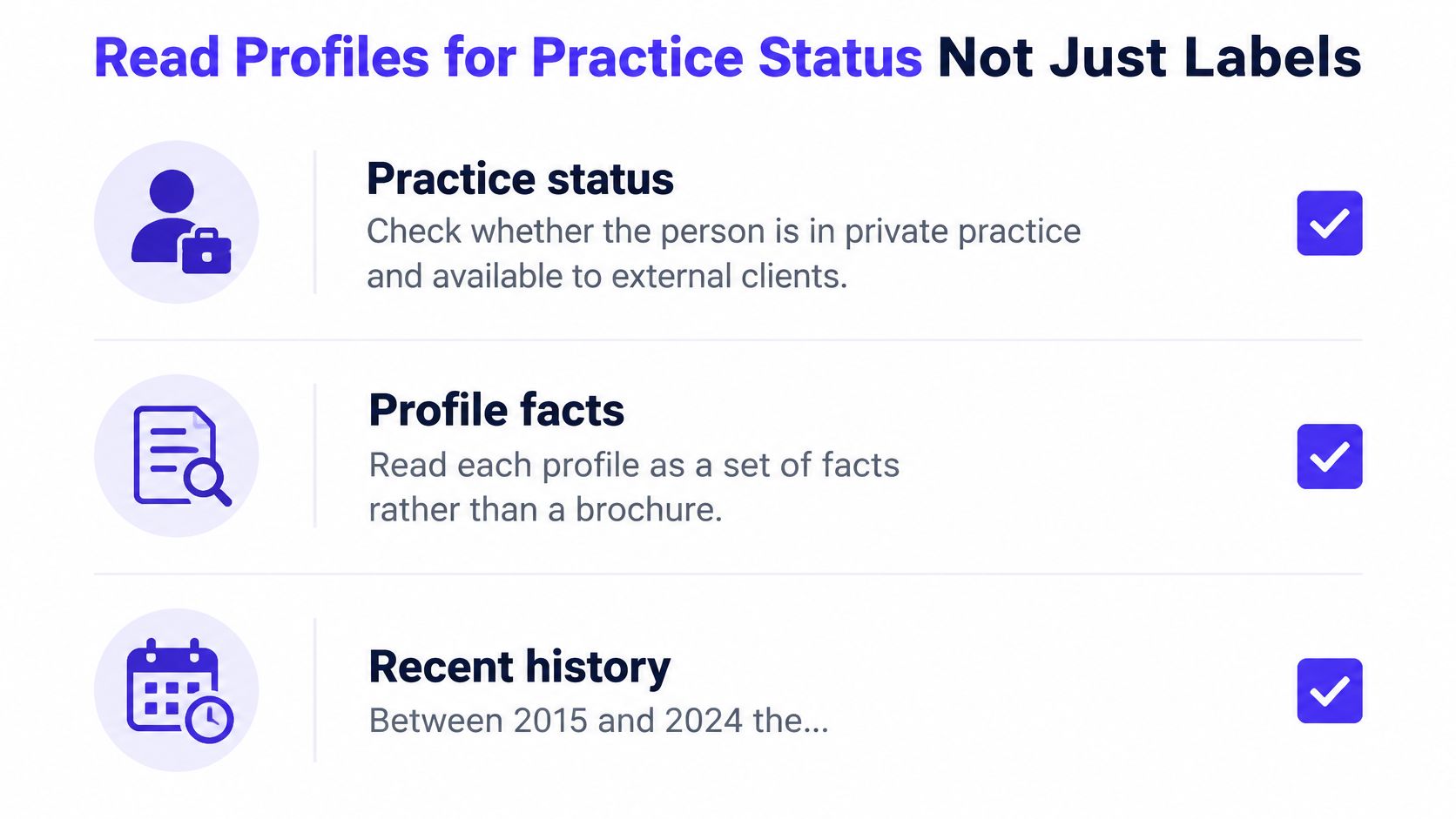
A profile should be read as a set of facts to examine, not a brochure to accept. Current role and access to external clients deserve attention before impressive titles or a familiar firm name.
Ministry of Law profession data referenced in the Legal Profession Symposium opening address shows that Singapore lawyers in practice grew by 26% between 2015 and 2024, while approximately 60% remained in law-firm practice after five years, falling to about 40% after ten years. For someone searching a directory, the practical lesson is that a lawyer's career history shouldn't be mistaken for their present position.
Separate professional background from current service
First, identify whether the person works in private practice or an in-house legal department. In-house counsel generally advise their employer rather than offering representation to members of the public.
Next, read the employer and office information together. An old biography may describe substantial law-firm experience even though the person has since moved elsewhere; a recognisable name doesn't resolve that uncertainty.
Look for a close connection between the stated work and what you need. A lawyer who describes company formation experience may be relevant to incorporation questions, but that description doesn't establish criminal-court experience.
Profile fields worth checking
| Profile field | Look for | Treat with caution |
|---|---|---|
| Practising role | Private practice open to external clients | In-house counsel presented as a public advocate |
| Practice areas | A close match to the matter | A long list with no related work |
| Office | A principal office you can reach | An old firm or mailbox address |
| Tenure | Current employer and years in that work | Years used as a proxy for quality |
| Contact | A working phone or email | A listing with no way to confirm availability |
Read experience in context
Years in practice are not a quality score. A long career may include different roles and fields, so ask what part of that experience relates to your matter.
The same care applies to broad labels such as commercial or family. Contract drafting and commercial litigation involve different tasks, just as an agreed family arrangement and a contested hearing may call for different experience.
Mark each candidate keep, query or drop. Keep a profile with a clear match, query one with a missing fact, and drop one dominated by unrelated work or an unsuitable practising role.
Don't fill gaps with favourable assumptions. A short question about current work is more useful than treating an extensive biography as proof of everything you need.
Weigh Reviews as Evidence of Real Work
A useful review describes work the lawyer performed. Praise about friendliness or office décor may tell you something about the meeting, but it won't tell you much about handling an employment negotiation or explaining a settlement.
Read feedback only after establishing a plausible practice match. Otherwise, an appealing review can distract you from a more basic mismatch between the lawyer's work and your problem.
Compare detail with a bare rating
Consider a hypothetical review describing a family conference. The reviewer says the lawyer explained the proposed arrangements beforehand, identified unresolved questions and sent a clear summary afterwards.
That account gives you subjects to investigate: preparation, communication and follow-through. It doesn't prove that the lawyer's legal assessment was correct, because you haven't seen the file or heard the other participants' accounts.
Now compare a five-star rating with no text. It records satisfaction, but gives you no basis for understanding what service the reviewer received.
A detailed review can help you form better questions. A star rating cannot answer those questions for you.
Neither example proves competence in your matter. Prefer a consistent pattern of relevant descriptions over a dramatic success story, while remembering that reviewers choose what to disclose.
Look for observable behaviour
- Communication: Did the lawyer explain unfamiliar terms and respond clearly to questions?
- Organisation: Does the account describe preparation, updates or attention to deadlines?
- Fee clarity: Did the reviewer understand the work being charged for?
- Relevant work: Was the service comparable to what you're seeking, rather than an unrelated transaction?
- Measured expectations: Does the feedback describe the process without suggesting a guaranteed result?
For context on how firms seek and manage feedback, Attorney Assistant's discussion of a review strategy for small law firms offers a useful perspective. Understanding review collection helps you distinguish the presentation of feedback from the underlying legal work.
A profile with no reviews contains missing information, not proof of poor service. Ask directly about comparable work, how the lawyer communicates and who would supervise the file.
Ignore promises that a past result predicts yours. Keep candidates whose feedback helps you investigate relevant behaviour, rather than just selecting the highest average.
Confirm Practising Status on Official Records
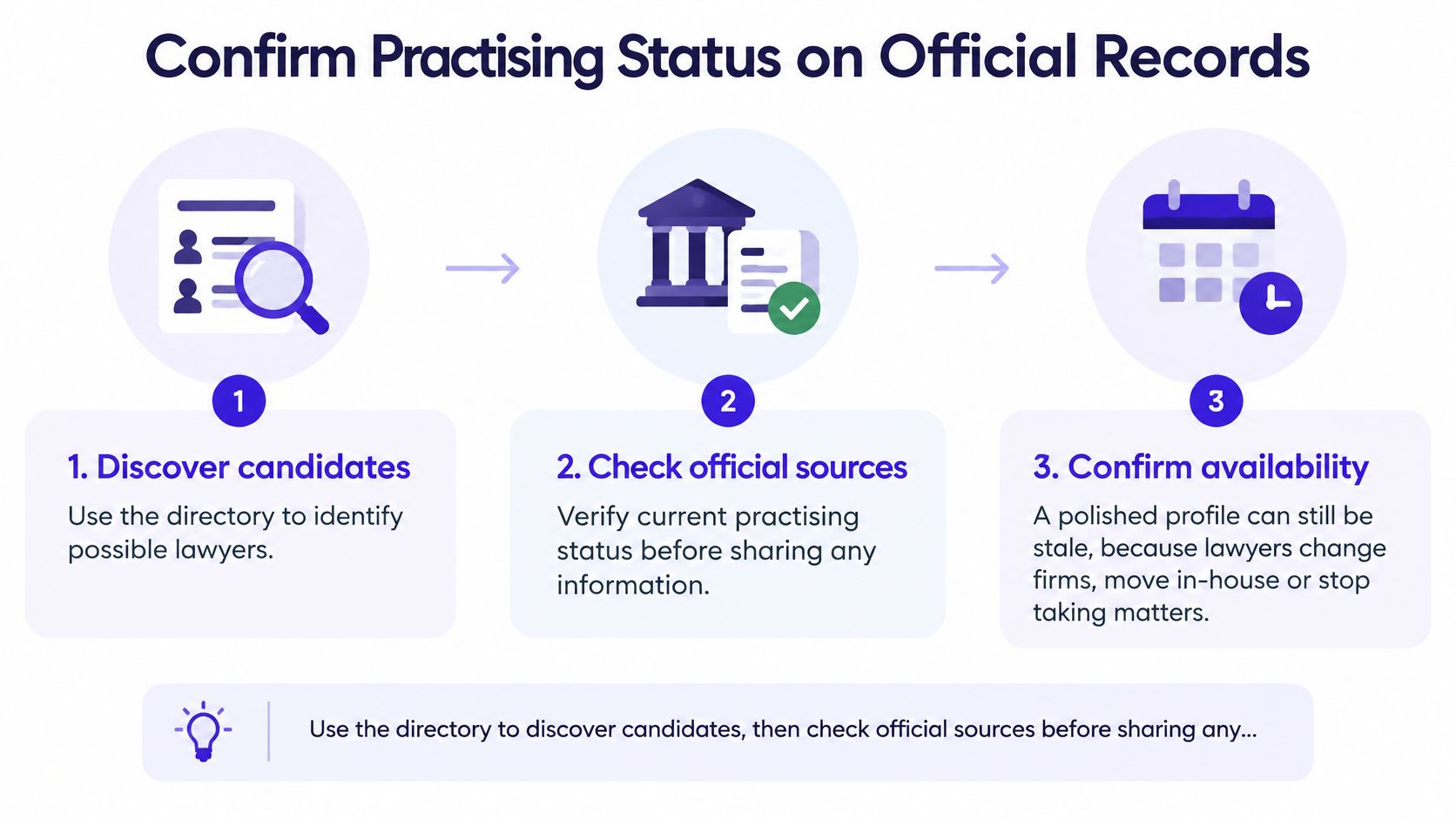
A polished profile can become outdated when a lawyer changes firms, moves in-house or stops accepting matters. Use official records to verify professional status before sharing documents.
The Lawyer Guide database is not an official register and may not always be complete or fully up to date; the official records of the relevant Singapore authorities are the authoritative source for practising or registration status.
Follow the verification sequence
The Singapore Courts' guidance on finding a lawyer identifies the regulatory authority's online directory as containing names, addresses and other useful information for practising lawyers in Singapore, and also points to the Law Society's Find a Lawyer service for searches by area of law.
- Record the identifying details. Copy the full name, firm and principal office from the profile. Similar names can lead you to the wrong person.
- Check the regulatory directory. Compare the official entry with the profile rather than relying on a matching surname.
- Use the practice-area search. Look for the lawyer through the Law Society's Find a Lawyer service under the relevant area of law.
- Resolve discrepancies. If the employer or status differs, treat the official record as authoritative and ask the lawyer to explain the difference.
A discrepancy may reflect an ordinary update, yet you still need to establish which firm and person you are contacting before sending anything confidential.
Keep status separate from suitability
A register entry works like a current membership card: it confirms the holder belongs, and says nothing about whether they can help with your particular matter. An official entry answers the professional-status question at the time you check it. Availability, experience with your exact dispute and willingness to accept your instructions remain open, and finding a name in a register creates no solicitor-client relationship. Confirm the proposed engagement directly with the lawyer, including who will act and what work they agree to undertake.
Verification boundary: A practising-status check clears the threshold for an enquiry. The decision to engage belongs to the comparison that follows it.
If you return to your search after a lengthy pause, run the status check again.
Follow Three Singapore Searches from Filter to Shortlist
The same method produces different shortlists for different problems. Three worked searches show how the same filters play out for a family matter, a dismissal and a commercial contract.

A parent considering divorce and care arrangements
A parent starts with Family, keeps the language they can comfortably use for sensitive discussions and looks for descriptions of Family Justice Courts work. They add a location filter only because travelling far for meetings would be difficult.
A profile focused on unrelated transactions drops out at this stage. A review describing how a lawyer explained care arrangements gives the parent a concrete question to raise in a first conversation. A profile without reviews stays only if its practice description is strong, and the parent marks the missing feedback as a gap to probe.
The parent doesn't switch to a different legal label merely because it appears in results. Reading about annulment of marriage in Singapore may help them recognise terminology, but whether it applies to their situation requires advice on their circumstances.
An employee dismissed after a dispute
The employee selects Employment and looks for work involving employment contracts, workplace disputes or negotiations. Criminal-defence experience and praise for conveyancing do not answer the questions raised by a dismissal.
A broad profile stays under consideration only if the employment experience is clear enough to investigate. Feedback matters for what it describes: careful explanation of documents and realistic timeframes tell the employee more than a reviewer's satisfaction with an outcome.
For the remaining candidates, the employee runs the practising-status check from the previous section. An unexplained difference in employer becomes a question to resolve, not something to overlook because the profile sounds reassuring.
A founder reviewing a customer contract
The founder searches company or commercial contracts and checks for private-practice lawyers who describe drafting and negotiating agreements. A large firm name alone doesn't establish experience with a startup's working arrangements or budget.
The founder looks for descriptions of comparable contract work and notes who might handle the drafting. Feedback about courtroom advocacy may be positive but doesn't show how the lawyer approaches a customer agreement.
Stop at three names per search and keep only those worth a focused conversation. For each name, carry forward the same checks used earlier: the practice match that connects the lawyer to the problem, the current firm and office, the most useful piece of feedback or a noted gap, and the result of the official status check. Drop candidates whose substantive work is mostly unrelated, and keep the comparison note short enough to scan in one glance.
Send a Focused Enquiry After You Compare
Contact the remaining lawyers with a short description that lets them assess relevance and availability. Include the matter type, rough timing, preferred language and any genuine need for a meeting in a particular area.
Don't attach a full bundle of confidential documents to the opening message. Ciphar's explanation of client confidentiality versus legal privilege provides useful background on why these concepts shouldn't be treated as interchangeable; ask the lawyer how to provide sensitive material before sending it.
Ask questions that make replies comparable
- Conflicts: Can the firm check whether it can act, and what names does it need for that check?
- Responsibility: Who would handle the file, and who would supervise?
- Initial cost: Is there a charge for the first discussion, and what does it include?
- Written scope: How will the proposed work, fees and advice be confirmed?
- Secure communication: What method should you use to send documents?
You can telephone or email the lawyer directly, or use an optional directory enquiry route. Discovery and contact are separate from advice and representation, which come from the lawyer you instruct.
Use a concise opening message
I'm seeking help with an employment matter involving a dismissal. There is a deadline stated in the correspondence, and I'd prefer to discuss the matter in English by telephone initially.
Please let me know whether you're accepting this type of work, what details you need for a conflict check, who would handle it and whether the first discussion is chargeable. Before I send documents, please confirm the appropriate way to share them.
Replace the example with your own facts and identify any stated deadline accurately. Compare replies for relevance and clarity, not speed or price.
If you're still uncertain whether private representation is affordable or necessary, pause and investigate assistance eligibility. This article provides general information only and does not represent legal advice on your case.
The Lawyer Guide Singapore helps you discover, compare and contact lawyers and law practices using information about their practice, experience and client feedback. Visit The Lawyer Guide to search your legal category, examine relevant profiles and prepare a shortlist for verification before making an enquiry.