Conveyancing Lawyer Fees Singapore: What Buyers Really Pay
Compare conveyancing lawyer fees Singapore for HDB and private homes, including stamp duty, disbursements and CPF costs. Informative only, not legal advice.
Four costs sit outside a conveyancing lawyer's headline fee in Singapore: stamp duty, registration charges, GST and CPF timing. Together they can outweigh the fee itself, which is why a conveyancing quote works like a budget airline fare. The headline number is real, but the extras decide what you pay.
That's the trap for first-time buyers comparing conveyancing lawyer fees in Singapore. You pick the lower of two quotes, then discover the disbursements and duties add far more than the gap between them. A lawyer's fee matters, but it is rarely the biggest cheque you will write.
Read every quote as a list of what is included and what is missing, rather than as a single price. A quote that looks cheaper on paper can still demand more cash from you on completion day.
Typical Conveyancing Lawyer Fees by Property Type
Property type drives the professional fee more than almost anything else. An HDB matter and a private property matter involve different work, different parties and, for HDB, a regulated fee framework that doesn't apply to private homes. Two quotes that look far apart may be pricing different categories of matter.
Typical professional fee ranges by transaction
| Transaction | Typical professional fee | Source |
|---|---|---|
| Private property purchase or sale through a private lawyer | S$2,500 to S$5,000 | Cashew, 2026 |
| HDB resale through a private lawyer | S$1,500 to S$3,000 | Cashew, 2025 |
| HDB transaction through the HDB in-house legal service | S$500 to S$2,000 | Cashew, 2026 |
The figures come from Cashew's 2026 guide to additional costs and fees and its 2025 guide to legal fees for buying a property. The two HDB rows sit side by side because they describe different routes: the in-house legal service, and hiring your own lawyer.
Ranges also shift depending on what a source bundles together. Singapore Legal Advice's 2024 guide to conveyancing lawyers put a general conveyancing lawyer at S$1,300 to S$3,000 for a property sale or purchase, a figure that blends HDB and private work, simple and complex matters, and firms with different scopes. Read each range for what it measures: which property types it includes, and which work it folds into the fee. That tells you which questions to ask a firm about your own matter.
What these figures don't cover
Every range above covers professional work only. Stamp duty, disbursements such as searches and registration, and any GST shown separately all sit outside the fee. Consider two quotes: one inside the range that excludes mortgage work, another above the range that includes it. Until you compare what's itemised, neither tells you which costs less overall. The same applies to the cash you need at completion, where duties and the timing of CPF funds often add up to more than the legal fee itself.
Sellers need the same caution. For an HDB resale, each party generally bears its own legal costs, while certain government fees and prevailing stamp duties remain separate obligations. Never assume the other side's lawyer, or the other side, absorbs your costs.
One more distinction matters for HDB buyers. The HDB range in the table is a market observation, and a statutory schedule governs HDB conveyancing charges, so any HDB quote should be checked against both. If you're still working out which kind of lawyer handles which matter, our overview of different types of lawyers in Singapore can help you narrow the search before you ask for prices.
Identify your property type and transaction structure before you compare any quote with these ranges.
This guide is informative and does not represent legal advice. Your own transaction may sit outside these bands, and only a lawyer who has seen your documents can confirm what you'll pay.
What Changes Your Conveyancing Quote
Five things move a quote, and they don't move it equally. Property type comes first because HDB and private matters follow different frameworks, so the same firm may price them differently from the outset. Transaction value comes next, since a higher price can raise the professional fee even when the steps look similar on paper.
Financing changes the workload in a way buyers often underestimate. A bank loan adds mortgage documentation, lender requirements and coordination around completion, and your lawyer has to satisfy the bank as well as you. CPF use adds another layer, because a CPF-funded private purchase involves lodgment work and the creation of a CPF charge. Complexity sits behind many surprises, whether it's a sub-sale, several buyers, a caveat that needs attention or a tenancy issue that has to be worked through before completion.

There's no universal price list
Buyers often ask for the standard rate, expecting a published tariff. The Law Society of Singapore's guidance on legal costs states that conveyancing fees aren't governed by a universal recommended price list, and that remuneration for non-contentious work such as conveyancing must be fair and reasonable under the circumstances. A solicitor and client may agree a fixed fee, a non-refundable retainer or a time-based arrangement.
That guidance also protects you in a practical way. Lawyers must provide an estimate of fees and disbursements and explain substantial changes to that estimate. Two firms may therefore lawfully quote different fees where the risk, financing complexity or amount of work differs, and neither quote is automatically wrong.
Two quotes for the same purchase
Say you're buying a private property with a bank loan and CPF funds. Firm A quotes a lower professional fee but its scope stops at the purchase itself, with mortgage work and CPF-related documentation billed as extras. Firm B quotes more, but its scope already covers title searches, registration, mortgage work, completion attendance and correspondence.
On headline price, Firm A wins. On total cost, it may not, because the extras arrive later when you've already committed and have little room to negotiate. You're not really comparing two prices. You're comparing two different lists of work that happen to share a label.
- Property type: Ask which framework applies to your HDB or private matter before you discuss numbers.
- Financing and CPF: Ask whether mortgage and CPF-charge work sit inside the fee or outside it.
- Fee structure: Ask whether you're agreeing a fixed fee, a retainer or time-based billing, and what triggers a change.
Compare scope before you compare totals. Once both quotes cover the same work, the cheaper one means something.
HDB Resale Fees Under the Statutory Schedule
HDB conveyancing charges don't rest only on what a firm chooses to quote. A statutory schedule covers transactions involving HDB flats, so an HDB quote has a fixed reference point that a private property quote doesn't have. Knowing which kind of HDB transaction you're in determines which set of rates applies.
The rates appear in two different units, and mixing them up produces wrong numbers. Under the Housing and Development (Conveyancing Fees) Rules, an HDB sale-and-mortgage transaction is charged per S$1,000 of value, a resale, transfer or assignment of flat ownership is charged in cents per S$100, and the schedule sets a minimum legal fee of S$21.80 inclusive of GST. Same bands, different units, different transaction types.
HDB conveyancing fee rates by transaction value band
| Transaction value band | Sale-and-mortgage rate | Resale, transfer or assignment rate |
|---|---|---|
| First S$30,000 | S$0.90 per S$1,000 | 13.50 cents per S$100 |
| Next S$30,000 | S$0.72 per S$1,000 | 10.80 cents per S$100 |
| Remainder | S$0.60 per S$1,000 | 9 cents per S$100 |
How to work through the bands
The bands are marginal. They work like income tax brackets: each rate applies only to the slice of value inside its band, so a flat priced above S$60,000 doesn't put the whole price on the remainder rate. Work through the slices in order.
- Identify the band: Split your transaction value into the first S$30,000, the next S$30,000 and whatever remains.
- Apply each rate: Multiply each slice by the rate for its band, using the correct schedule for your transaction type.
- Add the band amounts: Total the three results to get the calculated fee before other charges.
- Confirm rounding and GST: Ask your lawyer how rounding and GST are applied to that total. The calculated amount is rounded up to the next dollar before GST, and the schedule's minimum fee catches any result that falls below it.
A careful calculation can still go wrong on that last step. Two buyers can agree on the band maths and land on different final figures if one forgets rounding, GST or the minimum fee. Get the treatment confirmed in writing.
A worked example
Take a S$500,000 sale-and-mortgage transaction. The first S$30,000 at S$0.90 per S$1,000 costs S$27.00. The next S$30,000 at S$0.72 per S$1,000 costs S$21.60. The remaining S$440,000 at S$0.60 per S$1,000 costs S$264.00.
The total is S$312.60 before GST, disbursements and any other charges. Private-property conveyancing runs on negotiated market quotes rather than a statutory schedule, so an equivalent private quote typically prices higher than what this calculation produces.
Keep that figure in proportion. The legal line is only one part of the cash you need upfront: stamp duty, disbursements and the timing of your CPF drawdown can each outweigh the professional fee, so a low schedule result doesn't mean a low-cost purchase.
Practical rule: Treat the worked figure as an illustration of the schedule, never as a quote for your own flat.
The schedule applies to HDB flats only. A private property can't use it, and a private quote can't be checked against it. Confirm which framework your matter falls under before you accept any quote, and if your lawyer's number differs from your calculation, ask which transaction type and which rates produced it.
What a Private Property Quote Should Itemise
A private property quote should read like an itemised bill, not a single confident number. Singapore guidance confirms that buyers may separately incur Buyer's Stamp Duty, registration or lodgment fees, bank-related transaction fees, survey fees and legal fees, and the CPF Board's guide to HDB option fees and housing expenses shows that CPF treatment differs by item. If your quote merges all of that into one line, you can't tell what's negotiable, what's fixed by government, and what must be paid in cash.
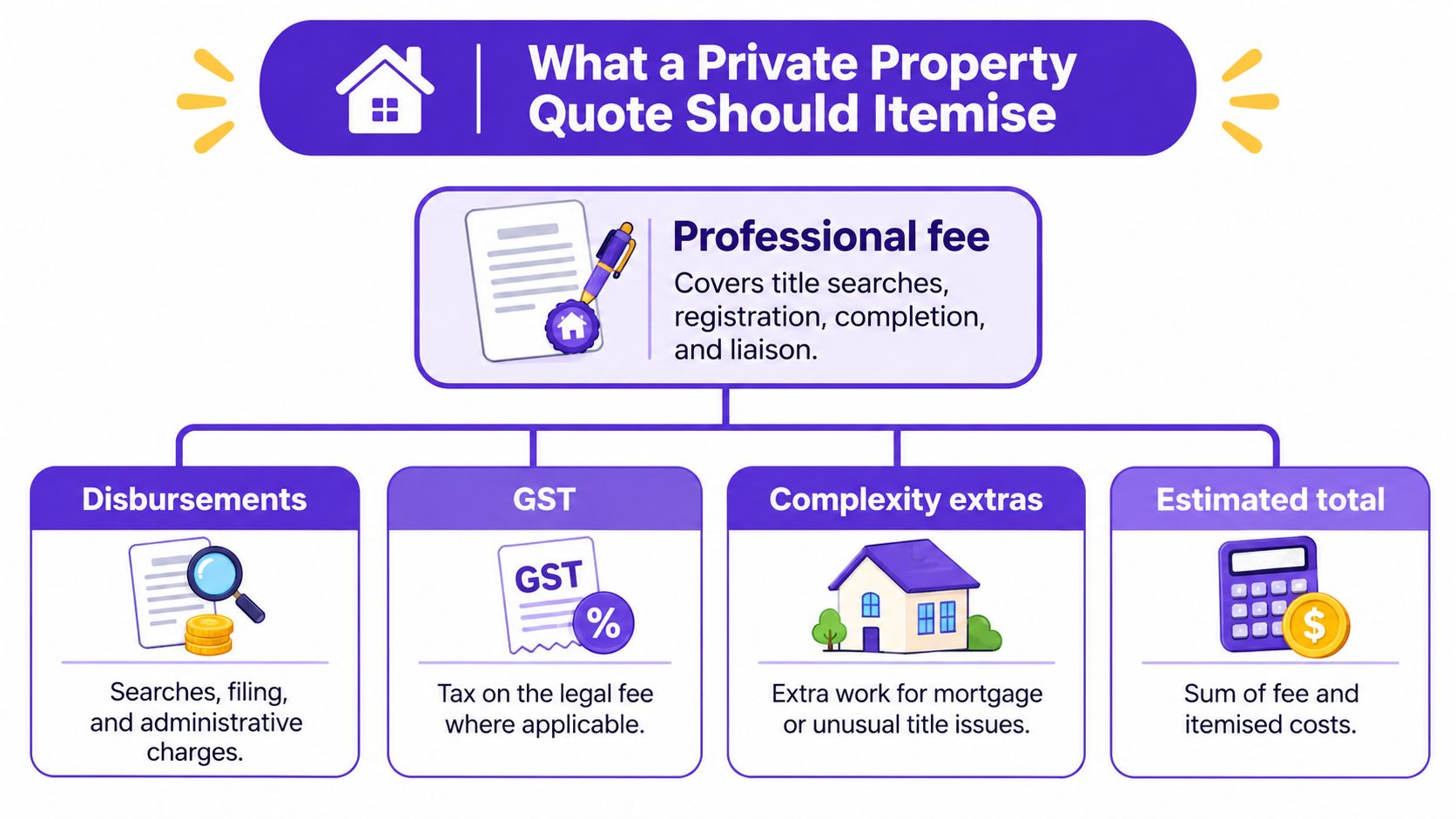
Components of a private property conveyancing cost
| Cost item | What it covers | Who sets the amount |
|---|---|---|
| Professional fee | Conveyancing work agreed in the scope of the engagement | Your lawyer, fair and reasonable under the circumstances |
| GST on professional fees | Tax on the lawyer's charge | Prevailing GST rate applied to the fee |
| Disbursements | Title searches, registration and lodgment charges | Government agencies and third parties |
| Buyer's Stamp Duty | Duty on the higher of price or market value | IRAS |
| Additional Buyer's Stamp Duty | Extra duty based on buyer status and property count | IRAS |
| Bank transaction fees | Lender-side work linked to the loan | Your bank |
| Survey fees | Property survey where one applies | Surveyor |
The lines buyers miss most often
Start with the professional fee and pin down its scope in plain words. Ask whether it covers title searches, registration, CPF-related documentation, mortgage work, completion attendance, correspondence and expected disbursements. Each item your lawyer can't confirm is a future invoice you haven't budgeted for.
Disbursements are the second blind spot because they sound minor and arrive in pieces. They're third-party costs your lawyer pays or arranges on your behalf, so they aren't the firm's income and they aren't usually negotiable. Ask for them as separate lines rather than accepting a lump sum labelled miscellaneous.
GST is the third. A quote stated exclusive of GST looks cheaper than an identical quote stated inclusive of it, and first-time buyers compare them side by side without noticing. Ask one direct question, is this figure before or after GST, and get the answer on the quote itself.
Reading a quote well is a document skill as much as a legal one. If you want a structured way to work through clauses, inclusions and exclusions before you sign anything, Documind's guide to reviewing contracts sets out a practical method you can apply to an engagement letter. Use it to prepare your questions, then put those questions to your own lawyer.
The lowest professional fee can still produce the highest upfront cash requirement once duties and disbursements are added.
Government duties belong on the quote as separate lines even though your lawyer doesn't set them and doesn't keep them. Seeing them early changes your cash planning, because a duty calculated on your purchase price will usually dwarf the fee you negotiated so carefully. A quote that shows only one figure needs follow-up questions before you rely on it.
Stamp Duty and ABSD Costs Beyond the Legal Fee
Many first-time buyers budget carefully for the conveyancing fee and overlook the duty. That ordering is backwards, because stamp duty is calculated on your property's value while a professional fee is calculated on work. The fee is the smaller lever by a wide margin.
The valuation point trips people up. You don't pay duty on the price you negotiated if the market value comes in higher. You pay on the higher figure, so a valuation above your agreed price raises your duty bill even though nothing about the deal changed.
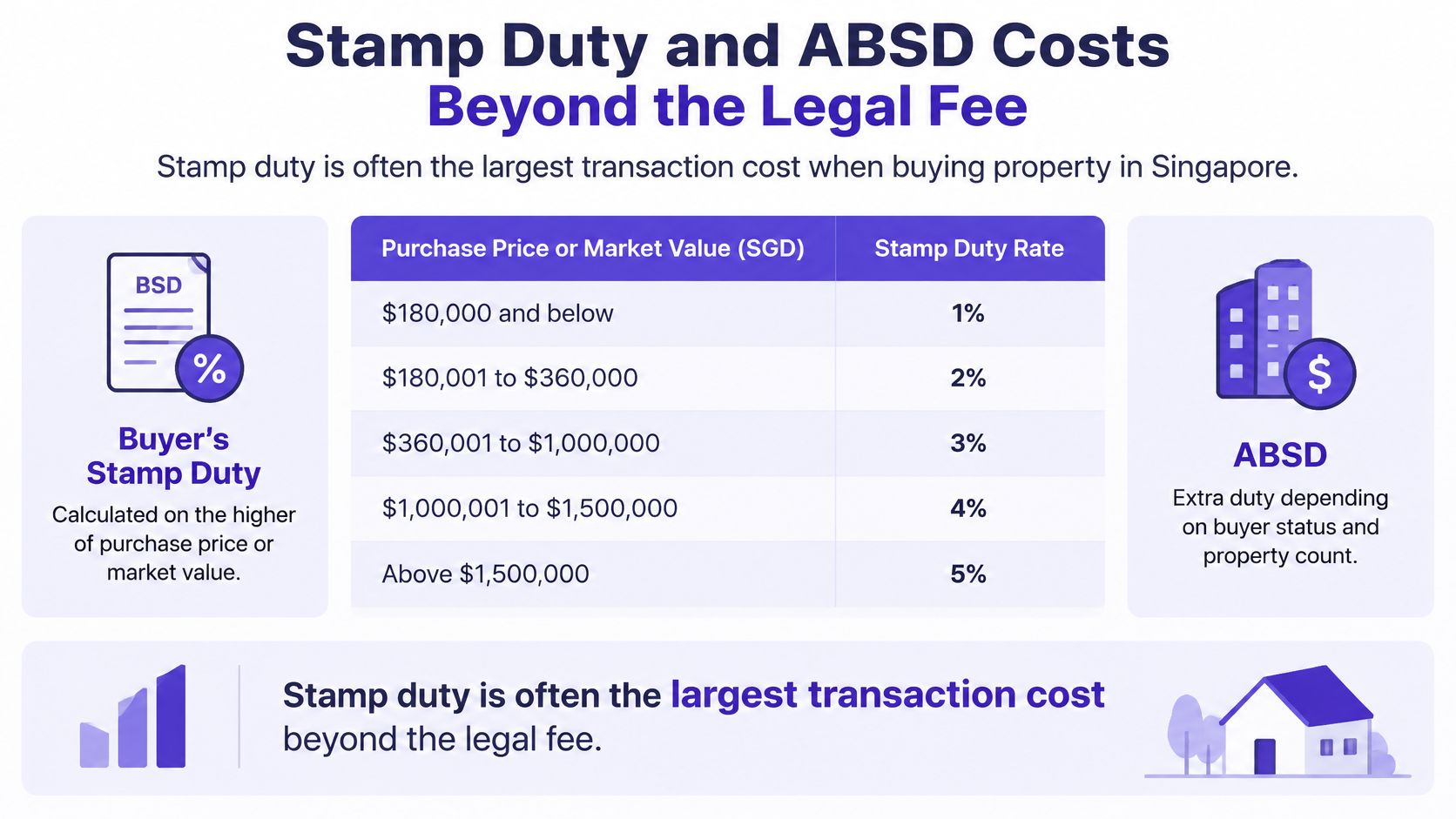
Buyer's Stamp Duty bands for residential property
IRAS guidance on Buyer's Stamp Duty) confirms that BSD is charged on the purchase price or market value, whichever is higher, and sets the following marginal rates for residential property acquired on or after 15 February 2023.
| Price band | BSD rate |
|---|---|
| First S$180,000 | 1% |
| Next S$180,000 | 2% |
| Next S$640,000 | 3% |
| Next S$500,000 | 4% |
| Next S$1,500,000 | 5% |
| Remainder | 6% |
The bands work like income tax brackets: each slice of the price is taxed at its own rate, and you add the slices together. On a S$1 million residential purchase, the first three bands produce BSD of S$24,600 before any legal fee, search fee or registration charge. Set that beside a professional fee in the low thousands and the priority becomes obvious. Saving a few hundred dollars on the lawyer while misjudging your duty leaves you short where it counts.
Additional Buyer's Stamp Duty
ABSD sits on top of BSD, and it depends on who you are and how many residential properties you already own. Under IRAS rates for Additional Buyer's Stamp Duty) applying from 27 April 2023, a Singapore citizen pays 0% on a first residential property, 20% on a second and 30% on a third or subsequent property. A Singapore permanent resident pays 5%, 30% and 35% respectively, while a foreigner generally pays 60% on any residential property and an entity generally pays 65%.
- Check your status: Citizenship or residency status sets the starting point for the rate.
- Count your properties: Your existing residential holdings determine whether this purchase is a first, second or later property.
- Confirm before you commit: Ask a Singapore lawyer to confirm the rate for your ownership circumstances before you exercise an option.
On a S$1.5 million purchase, a 20% ABSD rate alone comes to S$300,000 before BSD, legal fees or disbursements. No negotiation over conveyancing lawyer fees in Singapore will offset a duty of that size, so the order of operations matters: work out your ABSD position first, then compare lawyers.
This section is informative and does not represent legal advice. Duty treatment turns on your status, the property type and your ownership history, so get transaction-specific confirmation.
Paying With CPF and Cash Upfront
CPF-funded purchases cause the most cash-flow surprises because buyers assume their CPF balance covers the bill. It often covers part of it, later than expected, while some amounts have to leave your bank account first. The sequence matters as much as the total.
A lawyer isn't optional in this situation. The CPF Board's conveyancing panel guidance states that a conveyancing lawyer is required when a member first uses CPF savings to purchase a private property, because the lawyer prepares and lodges documents with the Singapore Land Authority and creates the CPF charge. That work is part of what you're paying for, and it should appear in your quote.
CPF savings may generally be used for legal fees through the appointed lawyer where a bank loan is involved. Even so, CPF panel guidance states that legal fees are borne by the member, and fees connected with CPF-related work may vary by the nature of the application and exclude GST. "Borne by the member" means the cost is yours, whichever account it eventually comes from.
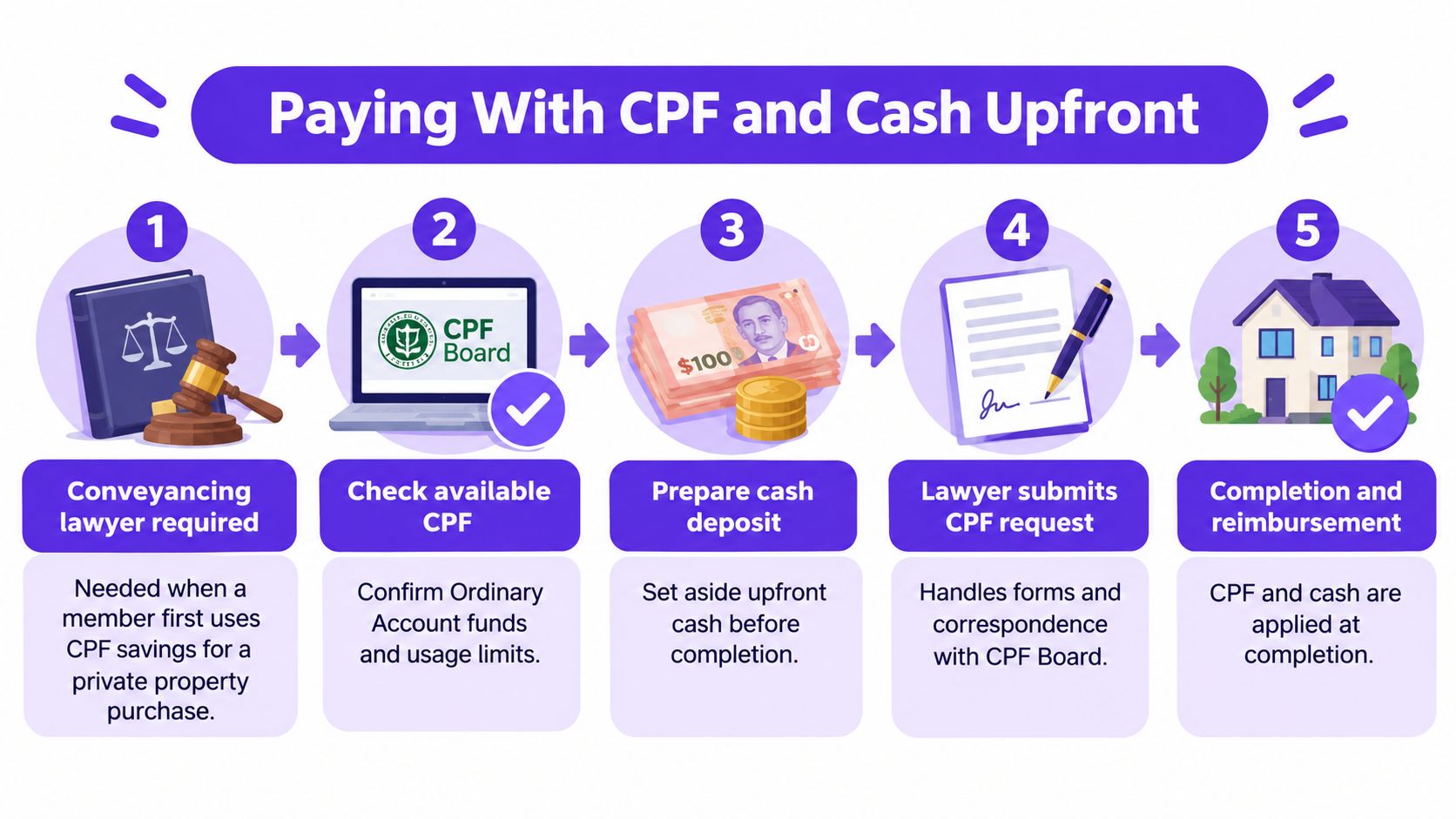
The payment sequence
- Confirm the loan and CPF plan: Settle your bank loan and intended CPF use first, because both determine what your lawyer must prepare and lodge.
- Ask for a CPF and cash split: Get your lawyer to separate CPF-payable items from cash-only items, including GST, SLA lodgment or registration charges, bank transaction fees and CPF-charge work.
- Pay stamp duty in cash on time: Stamp duty is generally payable to IRAS within 14 days of signing the sale-and-purchase agreement or accepting the option, so this deadline can arrive long before completion.
- Claim reimbursement where eligible: Certain property-related amounts, including stamp duty, may initially require cash payment before CPF reimbursement mechanisms apply, so treat reimbursement as money coming back rather than money you never need.
- Budget cash for the rest: Hold cash for GST and any cash-only charges so a small unexpected line doesn't delay completion.
Watch the timing: CPF reimbursement doesn't help you on the day a cash payment falls due.
The common mistake is assuming the whole lawyer's bill can be paid from CPF. Confirm each item's payment route in writing before you commit your cash elsewhere. A buyer with enough total funds can still run into trouble if too much of it sits in the wrong account at the wrong moment.
Confirm the Itemised Quote Before You Engage a Lawyer
Don't engage on a headline number. Engage on an itemised quote you can test line by line, because that's the document that tells you whether two firms are offering the same thing. A low professional fee can also distract from the bigger cash need: stamp duty, disbursements and CPF timing often outweigh the legal line itself. Use this checklist with every firm you approach, and ask for the answers in writing.
Your pre-engagement checklist
- Property type and schedule: Whether your matter is HDB or private, and whether the HDB statutory schedule governs the charges.
- Fee calculation: The transaction value used, and whether the fee is fixed, a non-refundable retainer or time-based.
- Written inclusions: Searches, registration, CPF-related work, mortgage work and completion attendance, each confirmed or excluded.
- Disbursements: Each search, lodgment and registration charge listed as its own line.
- Government charges: BSD and ABSD shown separately from the lawyer's fee where they apply.
- GST treatment: GST shown separately, with the quote stating clearly whether figures include it.
- Changes to the estimate: How you'll be told if the estimate moves, since lawyers must explain substantial changes to an estimate they've given.
Historical billing disputes show why this discipline matters. In a 1993 Singapore High Court decision, a solicitor charged S$6,725 for acting in a property purchase where the applicable scale fee was S$1,975, and charged S$3,000 for an application to lapse a caution where S$100 was properly chargeable. That's an old case under an older regime, but the lesson hasn't aged. A single bill can bundle conveyancing remuneration, application work and disbursements, and you can't challenge what you can't see.
Comparing lawyers before you commit
Testing quotes works best when you can reach several firms quickly. The Lawyer Guide Singapore helps people discover, compare and contact lawyers and law practices based on clear information about their practice, experience and client feedback, and its Singapore lawyer directory is one practical route to building a shortlist. Requesting offers through the platform is free and creates no obligation to hire, and The Lawyer Guide does not take a share of a lawyer's legal fees or charge a success fee based on the outcome of your matter.
Check each lawyer's practising status against official Singapore records before you engage anyone. A directory helps you compare; official records are the authoritative source for whether someone is entitled to practise.
This guide is informative rather than legal advice, and it can't substitute for advice on your own matter. Take your checklist, your transaction details and your CPF and loan position to a Singapore lawyer and get a quote built for your purchase.
If you want to compare firms side by side, The Lawyer Guide lets you request non-binding offers before you decide. Bring your property type, purchase price, loan and CPF position to each conversation so every lawyer prices the same scope of work.