Inheritance Law Singapore Explained for Families
See how inheritance law Singapore splits wills, intestacy and probate, including shares, court thresholds and Muslim or overseas cases.
You're sorting through a parent's papers after a death, and the questions arrive faster than the answers. Does the surviving spouse inherit everything? Can anyone access the bank account? Does the will cover the flat, CPF savings and insurance?
Inheritance law in Singapore doesn't send every asset down the same route. A family may need to apply intestacy rules to one account, follow a nomination for another asset and check the ownership arrangement for the home. Understanding those separate routes helps you avoid dividing money that isn't part of the estate in the first place.
How Singapore Inheritance Law Chooses a Route
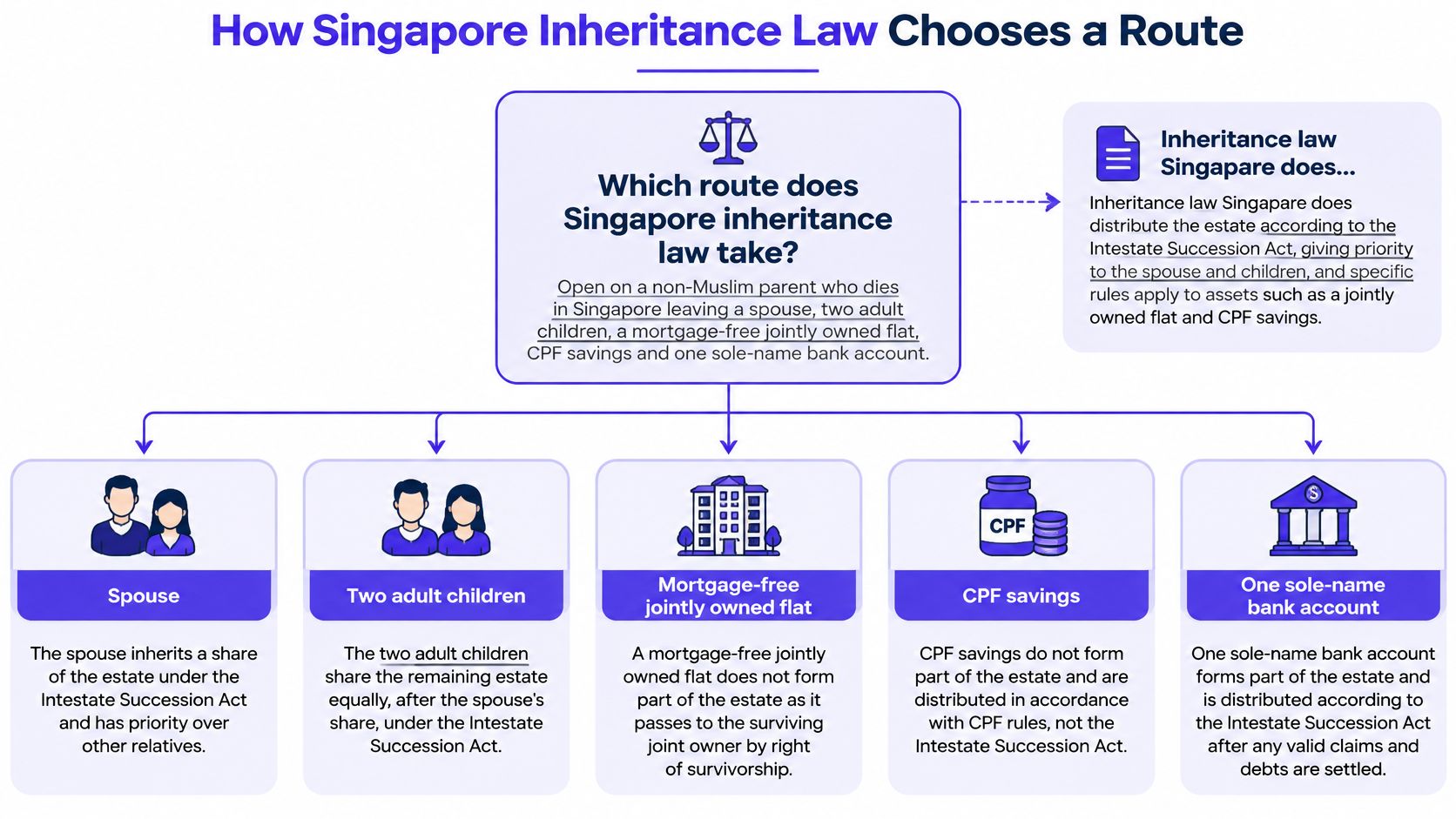
Say a non-Muslim parent dies in Singapore, leaving a spouse, two adult children, a mortgage-free jointly owned flat, CPF savings and one sole-name bank account. The family might reasonably expect to gather everything together, find the will and divide the total.
That's not necessarily how the estate works. Think of the assets as documents arriving at different counters, rather than money being tipped into a single pot.
The questions that determine the route
Is there a valid will? Where a valid will names an executor, the usual court application is for a Grant of Probate. Where there's no valid will, an entitled beneficiary generally applies for Letters of Administration instead.
Was the deceased Muslim? Muslim estates follow Muslim inheritance rules rather than the ordinary non-Muslim intestacy framework. A family shouldn't choose a distribution table before establishing which legal framework applies.
Does the asset require ordinary estate administration? CPF savings, jointly held immovable property with no outstanding mortgage and certain nominated insurance policies are examples of assets that may be distributed without a grant. The family must check each asset's actual ownership or nomination arrangement.
What the intestacy statute actually does
The Intestate Succession Act 1967 provides for distribution where someone dies without a valid will; its revised edition incorporates amendments up to 1 December 2021 and came into operation on 31 December 2021. It's foundational for non-Muslim intestate estates, but it isn't a universal instruction sheet for every asset someone owned.
A grant gives the personal representative authority to collect estate assets, settle debts and expenses, and distribute what remains. Being an intended beneficiary and having authority to administer the estate are different things.
Practical rule: Establish what belongs to the estate before calculating anyone's inheritance.
For families also dealing with a Hawaiian estate, the Olson & Sons probate guide provides jurisdiction-specific context. It shouldn't be used to decide a Singapore application or Singapore inheritance shares.
This article is informative only and does not represent legal advice. The share table below is a starting point for understanding qualifying non-Muslim intestate estates, not permission to distribute assets immediately.
Who Inherits When There Is No Valid Will
A spouse and children survive, but there is no valid will. Under the Intestate Succession Act's distribution rules, the spouse receives one-half of the estate, and the children share the other half equally per stirpes. The table shows how the statutory order changes with the surviving family members.
Start with the closest family class in the table. A more distant relative does not inherit under these rules while a closer entitled class survives.
Non-Muslim intestacy shares under the Intestate Succession Act
| Nearest surviving class | Who takes | Share |
|---|---|---|
| Spouse and children | Spouse and children | Spouse one-half; children share one-half equally per stirpes |
| Spouse, no children and no parents | Spouse | Whole estate |
| Spouse and parents, no children | Spouse and parents | Spouse one-half; parents share one-half equally |
| Children only | Children and descendants of a deceased child | Whole estate equally per stirpes |
| Parents only | Parent or parents | Whole estate, divided equally if both survive |
| Siblings, no closer class | Brothers, sisters and children of a deceased sibling | Whole estate equally with representation |
| Grandparents, no closer class | Grandparents | Whole estate equally |
| Uncles and aunts, no closer class | Uncles and aunts | Whole estate equally |
| No relative in these classes | The State | Estate passes to the Government |
“Children only” means there is no surviving spouse. The parents' row applies when there is neither a surviving spouse nor issue, meaning children or other qualifying descendants. Each later row applies only if the earlier entitled classes are absent.
What per stirpes means for a family
Per stirpes means distribution through a family branch. If a child died before the parent, that child's descendants may represent the branch and receive its share. The deceased child's branch is not automatically erased.
For example, a parent dies leaving a surviving daughter and a son who died earlier, leaving children. The son's children may take their father's branch share; the surviving daughter does not automatically receive the whole amount allocated to the children.
Marriage status can change which row applies. If proceedings leave it unresolved whether a marriage was annulled, that uncertainty may affect whether a person is treated as a surviving spouse for intestacy purposes. The effect of annulment of marriage in Singapore is therefore a specific issue to clarify before applying the spouse's share.
These defaults apply to non-Muslim estates governed by the Act. The route for particular assets can differ, as the next section's table explains.
Overseas rules are not substitutes for Singapore's. Families with a Georgia connection can read about who inherits under Georgia law for that jurisdiction's rules.
A valid will can set a different distribution for assets that pass under it. Without one, relatives cannot change the statutory shares by agreeing among themselves.
Wills Nominations and Incapacity Documents
Which document does which job? That's a more useful starting question than whether someone has completed estate planning. A will, a nomination and an incapacity document serve different purposes, even when they name the same family member.
Which route each asset takes
| Asset or situation | Route | Who receives it |
|---|---|---|
| CPF savings | CPF nomination | Nominee, outside the will |
| Insurance policy with valid nomination | Nomination | Nominee paid directly |
| Mortgage-free joint property held as joint tenants | Survivorship | Surviving owner |
| Sole-name property and bank accounts | Will or intestacy with grant | Beneficiaries under the will or applicable intestacy law |
| Muslim estate | Faraid with Syariah Court certificate | Faraid heirs |
| Assets abroad | Foreign law, local probate or resealing | Beneficiaries determined under the applicable law, considering domicile and asset location |
The CPF row describes savings covered by a nomination. If there isn't one, don't assume the will takes over. Likewise, the insurance row concerns a valid nomination, not every policy that mentions a family member.
For property, check the title rather than relying on the phrase jointly owned. Joint tenancy and ownership in separate shares aren't interchangeable. The survivorship route in the table concerns property held as joint tenants.
A usable will needs proper execution
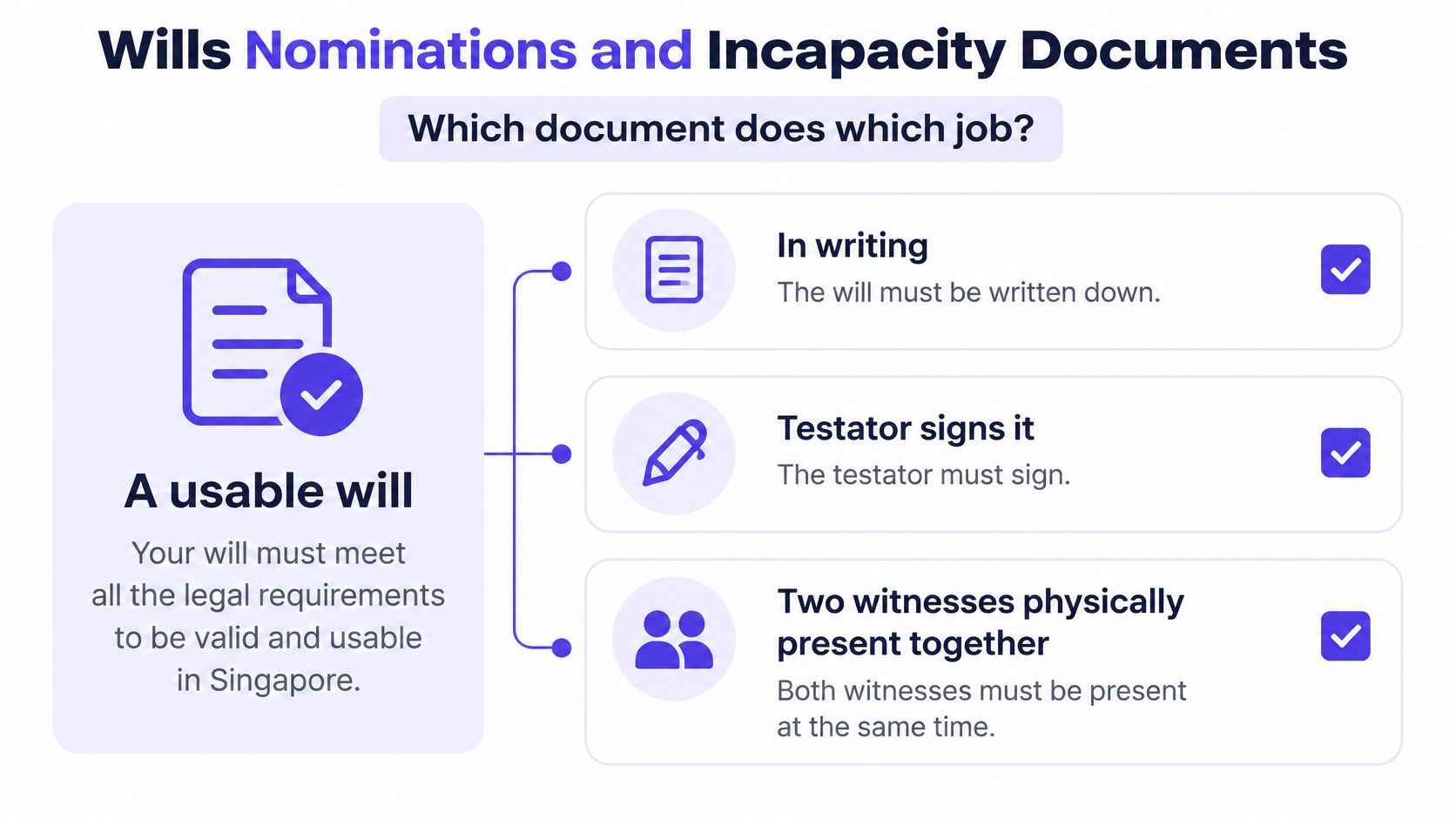
For an ordinary Singapore will, the basic execution requirements include writing, the testator's signature and two witnesses physically present together. A beneficiary, or a beneficiary's spouse, acting as a witness can cause the gift to that beneficiary to fail. Choose witnesses carefully rather than treating witnessing as an informal family favour.
A will can name an executor, make specific gifts, distribute the residue, meaning what remains after the other estate obligations and gifts, and appoint guardians for minor children. It governs assets falling into the estate, not every asset appearing in the person's financial records.
Don't assume a foreign will automatically governs Singapore land. Equally, a Singapore will shouldn't be assumed to resolve every overseas account or property without further legal work.
Incapacity planning isn't inheritance planning
A Lasting Power of Attorney, or LPA, concerns decision-making during mental incapacity. It doesn't distribute the estate after death. An Advance Care Plan records care wishes and doesn't transfer property.
The Ministry of Law's 2025 written reply on wills describes MyLegacy@LifeSG as bringing together information on wills, LPAs, Advance Care Plans and CPF nominations. Having these topics together helps families organise their planning, but doesn't merge their legal functions.
A person trusted to make decisions during incapacity isn't automatically the executor or the beneficiary after death.
This distinction matters when organising the family folder. Label documents by purpose so relatives can distinguish authority to act during life from instructions that operate after death.
Make the documents and assets findable
Use a practical checklist while the person can explain what they own and where the records are:
- List the assets and accounts. Include bank accounts, brokerage holdings, cryptocurrency, cloud files, email, insurance and CPF. Record the institution or account category and where supporting documents are kept.
- Name a trusted contact. Someone should know where the original will is stored and how to reach the executor. A digital copy can help identify the document, but shouldn't be treated as a substitute for locating the original.
- Record recovery steps securely. Explain where account-recovery instructions are kept without writing passwords or sensitive access credentials into the will.
- Review the arrangements together. Check whether nominations and testamentary gifts produce the intended overall result. Don't assume changing the will also changes a nomination.
The Government reported more than 153,000 wills deposited with the Singapore Academy of Law Wills Registry as of 1 April 2025, as discussed in the international estate-planning overview. Deposit is voluntary and doesn't determine validity.
Treat the registry as a finding aid, not proof that a document is valid or remains the latest will. If relatives believe a will exists, search for it before proceeding on the assumption of intestacy.
This article is informative only and does not represent legal advice.
Court Routes Deadlines and Estate Thresholds
Knowing who inherits does not by itself give anyone authority to collect estate assets or transfer property. That authority comes through an estate-administration process, which determines who may act and which court handles the application.
Probate thresholds and timing in Singapore
| Item | Rule | Figure |
|---|---|---|
| Small estate | Public Trustee may administer without a grant if conditions are satisfied | Not more than S$50,000 |
| Family Courts | Court for the grant application | Estates up to S$5 million |
| High Court | Family Division of the High Court | Estates above S$5 million |
| Filing window | Probate application should be filed; delay must be explained | Within 6 months of death |
| Processing | Indicative time, varying with complexity | About 2 to 3 months |
| Probate waiting period | Grant generally cannot issue earlier unless the Registrar permits | 7 days after death |
| Administration waiting period | Grant generally cannot issue earlier unless the Registrar permits | 14 days after death |
The Singapore Courts' probate and administration guidance explains these thresholds and timing rules. The small-estate route is conditional: the Public Trustee must agree to administer the estate, and a modest balance alone does not establish eligibility.
The deadlines answer different questions. The filing window concerns when to apply, while the waiting periods set the earliest point a grant may issue. The indicative processing time is an estimate, not a promised completion date.
A sensible application sequence
- Gather death documents and financial records. Identify assets and debts, then use the routing table in the previous section to distinguish estate assets from those handled through another process.
- Search for the original will. Check organised papers and established document-storage arrangements. Record enquiries to avoid repeating searches or overlooking a likely custodian.
- Identify the applicant and grant. A named executor ordinarily applies for probate where there is a valid will. Without one, an entitled beneficiary generally applies for letters of administration.
- Choose the court route. Establish the estate value before filing. If ownership or valuation is uncertain, clarify it rather than relying on a rough family estimate.
- Administer before distributing. Once authorised, collect relevant assets, pay debts and expenses, and distribute what remains. Keep records of receipts, payments and transfers.
A grant works like a key: it gives an authorised person power to act, but it does not decide beneficiaries' shares. Those shares come from the applicable inheritance rules.
Before distributing anything, the executor or administrator needs a sufficiently complete picture of the estate's obligations. Otherwise, money paid out too soon may leave debts or expenses unpaid.
Muslim Estates and Assets Across Borders
A family's starting point can change because of the deceased's religion or connections overseas. These aren't minor exceptions to a standard table. They can change both the applicable inheritance rules and the documents needed to administer assets.
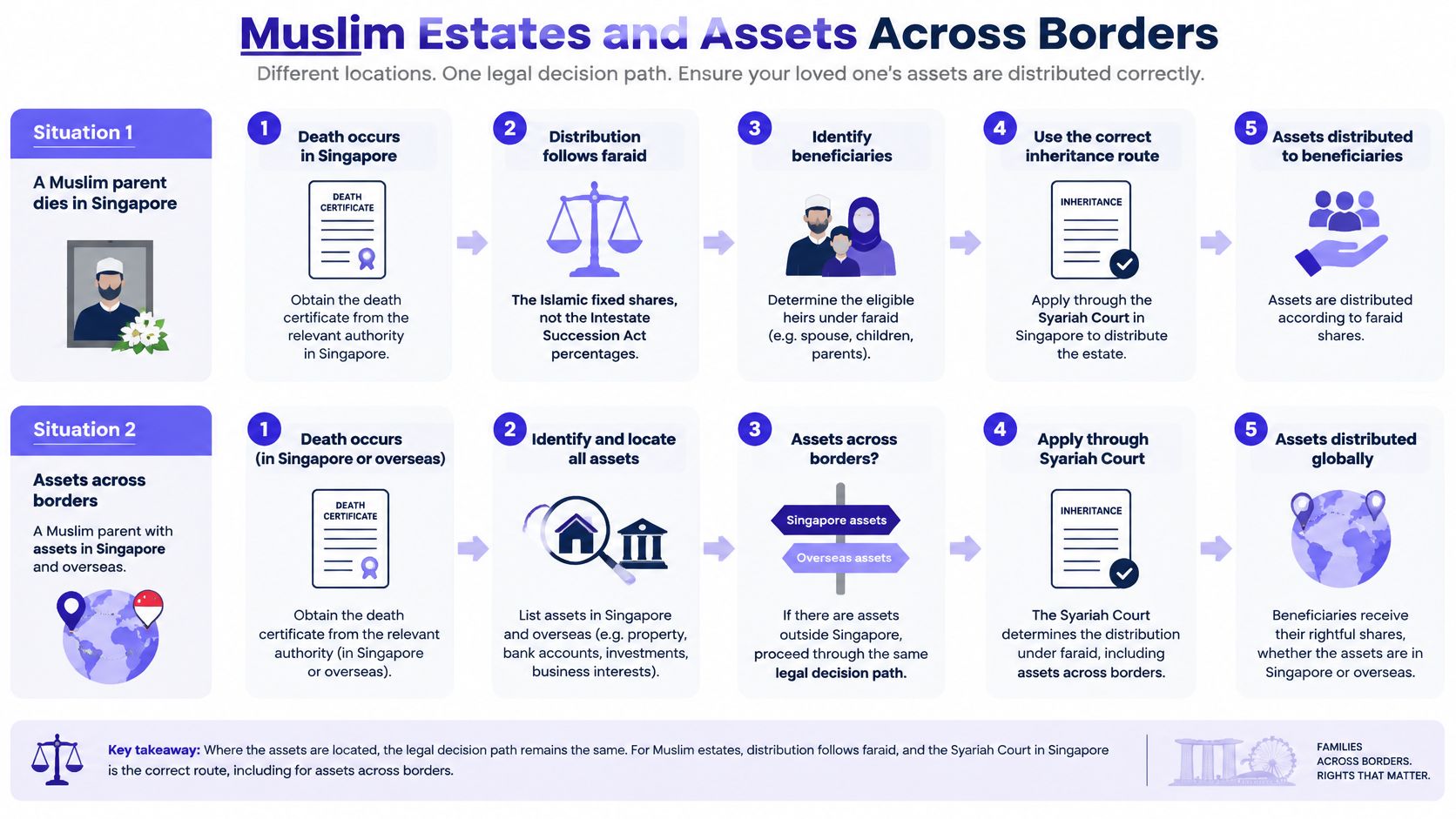
A Muslim parent dies in Singapore
For a Muslim estate, distribution follows faraid, the Islamic law of fixed inheritance portions. The Syariah Court's inheritance overview explains that an Inheritance Certificate identifies recognised faraid beneficiaries and their respective shares, and may be required by the Public Trustee or for a Family Justice Courts grant application.
The certificate addresses entitlement based on the family circumstances supplied. It doesn't replace the estate-administration process or establish that every factual assertion is correct.
Under section 115 of the Administration of Muslim Law Act, the Syariah Court's jurisdiction guidance explains that certification rests on stated or hypothetical facts, without hearing evidence or deciding disputed factual questions. Only beneficiaries recognised under Muslim law are certified.
If relatives disagree about a family relationship, a debt or a document's validity, obtaining the certificate doesn't itself settle that dispute. The family may need another process to resolve the facts before completing distribution.
Applications go through the SYC Portal, using SingPass for individuals or CorpPass where applicable. Under the Inheritance Certificate application process, each submission is processed within seven days, and the application remains valid for 60 days, during which the required tasks must be completed.
After supporting documents are verified and approval is given, the applicant downloads the Statutory Declaration template and affirms it before a Commissioner for Oaths. The affirmed declaration is uploaded for verification, followed by payment and download of the certificate as a PDF.
A non-Muslim dies domiciled overseas
Now consider someone domiciled overseas who leaves a Singapore flat and a foreign bank account. Singapore intestacy rules generally govern Singapore immovable property, while succession to movable property may follow the law of the deceased's domicile.
Domicile isn't another word for citizenship or the address used for correspondence. Establishing it can require a legal assessment of the person's circumstances and connection to a permanent home.
Use this decision path:
- Religion. Establish the applicable Muslim or non-Muslim framework.
- Domicile. Identify the relevant legal home, rather than assuming nationality decides everything.
- Asset type and location. Separate land and buildings from movable assets such as account balances.
- Authority to act. Determine whether a Singapore grant is sufficient or whether another jurisdiction requires local probate or recognition through resealing.
Overseas accounts, foreign land, dual citizenship and foreign wills need coordinated assessment. A spouse shouldn't assume they receive everything merely because they're the closest surviving adult.
This article is informative only and does not represent legal advice.
Find a Wills and Probate Lawyer in Singapore
A straightforward non-Muslim estate may be easier to understand after checking the family relationships, asset routes and court requirements. Understanding those rules, however, isn't the same as being ready to administer the estate.
When professional help is sensible
Consider appointing a lawyer where:
- The will is missing or challenged. Relatives disagree about whether it exists, whether it's valid or which version applies.
- Beneficiaries need protection. Minor children are involved, or heirs disagree about the proposed administration.
- The legal framework needs specialist assessment. The estate is Muslim, assets sit overseas or domicile is uncertain.
- The administration exceeds the small-estate route. A court application, contested ownership or more involved asset collection needs attention.
Before making contact, gather the death certificate, any will, an asset-and-debt list and nomination records. Mark gaps clearly rather than postponing the enquiry until every document has been found.
At The Lawyer Guide, we help readers discover, compare and contact lawyers and law practices using information about their practice, experience and client feedback. You can search by expertise, location or name, read profiles and contact lawyers by phone or email; listed expertise includes Wills, Probate & Estate Administration.
Check status before appointing anyone
Our database isn't an official register and may not always be complete or fully up to date. Check practising or registration status against the authoritative records of the relevant Singapore authorities.
Ask the lawyer to clarify the proposed scope of work, who will handle the matter and how fees will be charged. This article is informative only and does not represent legal advice. Advice and representation come from the lawyer you appoint, not from the directory.
The Lawyer Guide offers lawyer profiles and client feedback to help you compare professionals handling inheritance and estate administration. Visit The Lawyer Guide to find a wills and probate lawyer, and prepare your documents so you can discuss the estate's specific needs.